
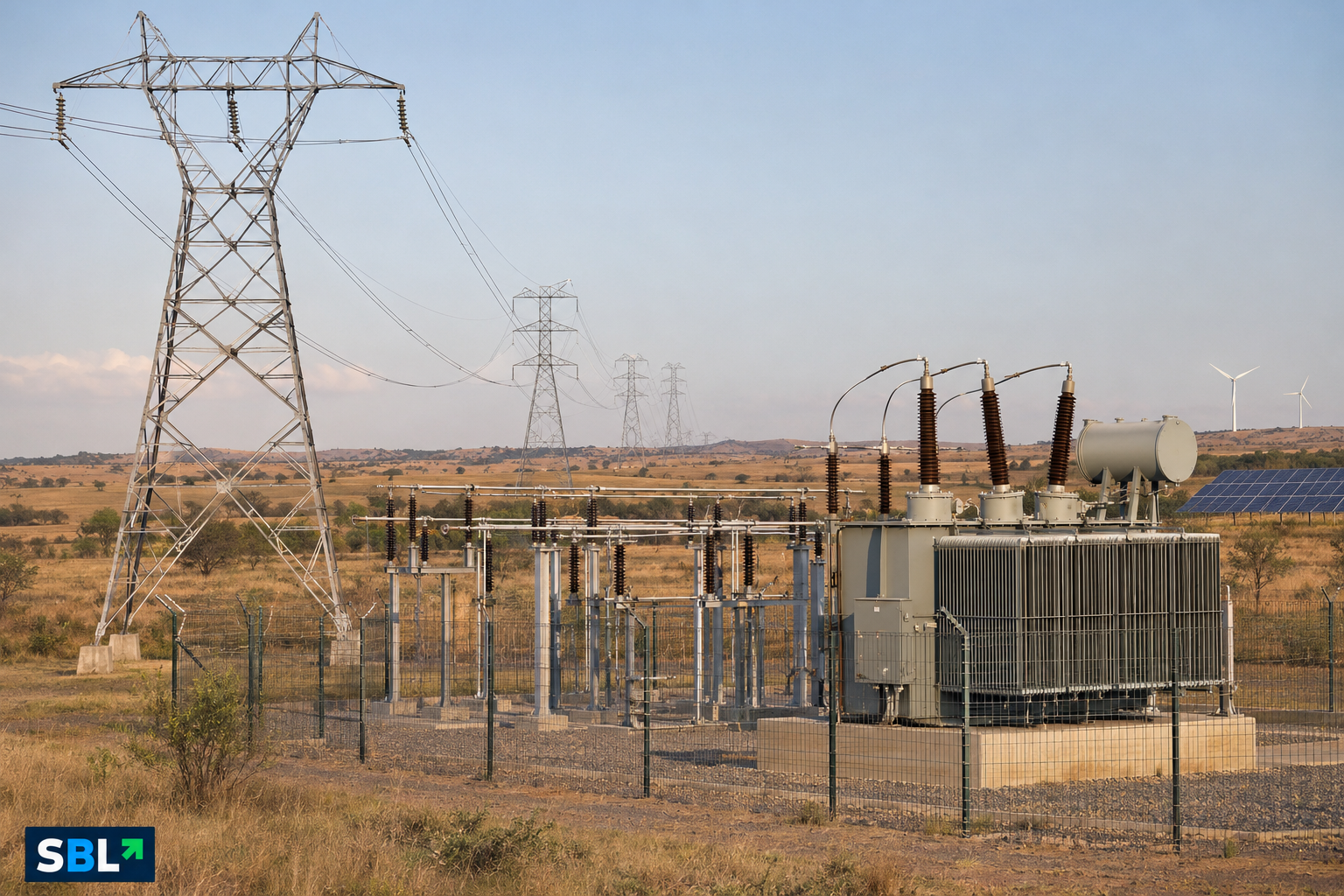
AI-generated editorial illustration, not an actual facility.
Treasury’s director-general says the national grid has become the constraint on new electricity investment. His renewed warning comes with final proposals for the first private transmission projects now targeted for the second quarter of 2027, under a timetable revised in October.
South Africa needs more than R100 billion to expand and modernise its electricity grid, National Treasury director-general Duncan Pieterse told investors on Wednesday, 11 November. Most of that investment will have to come from private investors, he said.
The warning shifts attention from building power stations to the network needed to carry their electricity. It also raises a practical question: how quickly can projects move from financing plans to construction?
Pieterse spoke at the Old Mutual Investment Group Tomorrow Investment Summit in Cape Town, according to SAnews’s 11 November report. His statement is a renewed assessment of the investment need, not an announcement that R100 billion has been raised or awarded.
A procurement deadline has already moved
An official Department of Electricity and Energy and Treasury update dated 1 October sets out the revised timetable for Phase I of the Independent Transmission Projects programme.
The final request for proposals, previously promised by the third quarter of 2026, is now targeted for the second quarter of 2027. Phase I covers approximately 1,164 kilometres of new transmission infrastructure. These dates concern the invitation for final proposals, not the completion of power lines.
A second draft package is due to go to seven pre-qualified bidders before the end of 2026. Government says further targeted consultation is needed to resolve commercial and financing issues before binding bids. Its stated aim is stronger competition, clearer risk pricing and fewer protracted negotiations later.
That delay was disclosed in October. It is not a new postponement announced in Pieterse’s speech.
Who controls access matters too
Pieterse said new generators need equal access to the grid and competitive treatment alongside Eskom’s power. The National Transmission Company South Africa exists as an Eskom subsidiary; the next step he described is a fully independent, state-owned transmission system operator owning and controlling the transmission assets.
Private investment and an independent state-owned operator are therefore different parts of the reform. The former concerns capital and project delivery. The latter concerns how access and system operations are governed. Neither should be presented as a completed sale of the national grid.
What this means for households and businesses
SBL analysis: A new generator is of limited use to customers it cannot reach. More grid capacity can allow additional suppliers to compete and create opportunities for construction, equipment and engineering businesses. But an investment target is not a lower electricity bill.
Households should not read the announcement as a promised tariff cut or a date when local faults will end. The speech provides neither. Businesses weighing new electricity supply arrangements still need workable connections, contracts and delivery dates, rather than relying on national investment ambitions alone.
The trade-off in the procurement is also real: rushing a poorly structured project can create expensive disputes, while repeated delays postpone infrastructure. Government argues that more preparation now will improve later delivery. Whether it achieves that can only be judged as the process advances.
What to watch next
The immediate tests are the second draft package before year-end and whether the final request for proposals reaches the revised 2027 window. Those are milestones to monitor, not guarantees of construction or supply.
SBL’s earlier reform review distinguished working services from plans and prototypes. The same distinction matters here: money sought, bids invited and power lines energised are three different stages.
The bottom line: Treasury has identified the grid as a major obstacle to the next phase of electricity investment. The reader’s test is whether a financeable procurement becomes infrastructure, not simply whether another funding ambition is announced.
AI-assisted draft prepared and source-checked 12 November 2026 for Tristan van Niekerk’s editorial review, pending. Sources: SAnews, 11 November 2026; Department of Electricity and Energy/National Treasury, 1 October 2026. No new tariff saving, construction completion date or funding award is asserted.

Leave a Reply