
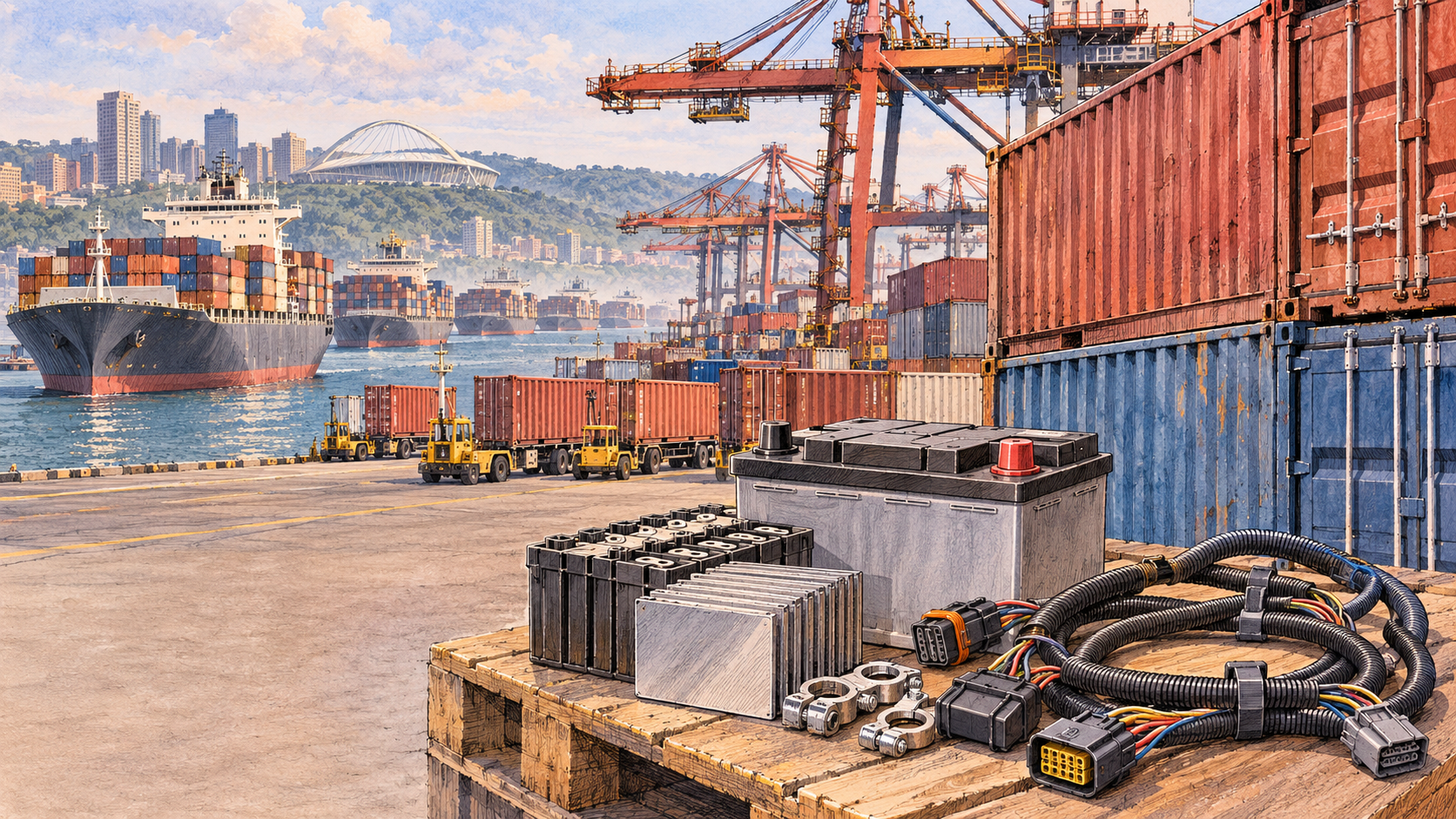
Metair says congestion at the Port of Durban has pushed it into costly airfreight, overtime and production disruption, with the extra bill now estimated at 20% to 25% of a key operating earnings measure it reported for 2025, before exceptional items.
Metair has warned that disruption at the Port of Durban could add costs equal to as much as a quarter of its 2025 earnings before interest, tax, depreciation and amortisation (EBITDA), before exceptional items. EBITDA is a measure of operating performance before financing, tax and non-cash depreciation and amortisation charges; it is not net profit.
The JSE-listed automotive-components group said in a trading update on Friday that delays at the port had at times approached 20 days. A new terminal operating system, equipment failures and limited crane availability had disrupted container handling, it said.
Metair estimated that the additional costs incurred and expected for the year ending 31 December 2026 would amount to about 20% to 25% of that operating earnings measure for the year ended December 2025. The estimate has not been audited or reviewed by its external auditors.
Airfreight, overtime and a stopped production line
The company said it had used airfreight as a substitute since August, describing the associated costs as exorbitant. Late deliveries also forced additional overtime and contributed to the temporary stoppage of one customer’s production line.
Higher stock in transit, extra safety stock and longer ordering lead times have increased working-capital pressure. Metair said these extra costs could not be recovered from customers.
The group also reported several breakdowns since August at an industrial electron-beam machine used by subsidiary Unitrade 745. The machine has since been repaired and operations have stabilised over recent weeks.
Congestion may continue into 2027
Metair said serious congestion remained at the port and that meaningful improvement might not arrive before the end of the first quarter of 2027.
If conditions persist, the group may be unable to meet some commitments to customers and suppliers. It said it could then consider force-majeure provisions or other rights available under South African law where the disruption is beyond its reasonable control. That is a warning about a possible future step, not an announcement that Metair has invoked force majeure.
The company is engaging its primary lender, customers and other stakeholders to manage the impact. It also said outstanding government decisions continued to weigh on manufacturing competitiveness, localisation, complete-knock-down vehicle production and export markets.
Metair’s statement is company-specific, but it highlights how port failures can move beyond shipping delays into factory schedules, inventory financing and customer commitments.
Source: Metair operational and trading update, 13 November 2026
What does the 20% to 25% estimate actually mean?
It is a comparison with last year’s operating earnings measure, not a forecast that revenue, net profit or the share price will fall by the same percentage.
SBL calculation: set the specified 2025 earnings measure to an index of 100. Metair’s estimated extra costs then equal 20 to 25 on that same scale. Subtracting them leaves 75 to 80 only in an illustration where everything else stays unchanged. It is not a forecast of 2026 earnings: sales volumes, margins and other expenses can also change.
The index uses no assumed rand earnings figure. It simply translates the company’s stated percentage range. The estimate combines costs already incurred with expected costs and remains unaudited.
Why extra stock does not solve the whole problem
There are two separate pressures here. Airfreight and overtime increase the expense of getting components delivered. Holding more safety stock and goods in transit also ties up cash before that stock can be used or sold. The first affects costs; the second affects when cash is available. They should not be treated as interchangeable measures of loss.
Metair says the additional costs cannot be recovered from customers. That makes this an immediate supplier-margin and cash-management story, not evidence that motorists will receive a matching increase in car prices. Nor does disruption at one customer’s production line prove a nationwide vehicle shortage.
The evidence that would change the picture
- Metair’s next financial update: whether the cost range changes, and how actual cash flow and earnings compare with the estimate.
- Operational evidence: whether deliveries become reliable enough to reduce emergency freight and safety-stock requirements.
- Contractual action: whether the group actually invokes any provisions. Its current statement only raises that possibility.
SBL assessment: Port delays can damage a manufacturer twice, through expensive workarounds and cash tied up in stock. Metair has quantified one part of that pressure, but the announcement is not a complete forecast of its annual results.
Analysis added 14 November 2026, using Metair’s SENS announcement of 13 November 2026. The index calculation is SBL’s explanatory illustration, not company guidance or an investment recommendation.



Leave a Reply