

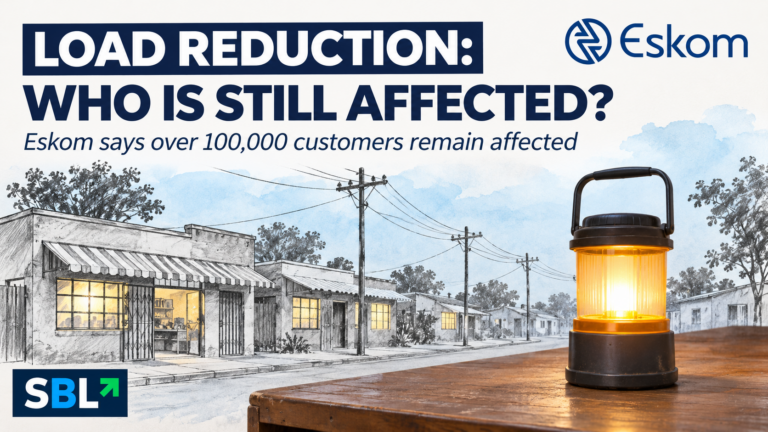
In its dated power-system update of 13 November 2026, Eskom reported no week-on-week improvement in its load-reduction footprint: 1,591,837 customers had been removed from schedules, while 102,551 customers in parts of Gauteng and KwaZulu-Natal remained affected by the targeted network-protection measure.
Clarification, 13 November 2026: Eskom’s separate, undated load-reduction webpage states: “Eskom is no longer implementing Load Reduction.” This conflicts with the dated 13 November update discussed here. SBL has not resolved the discrepancy or established which statement reflects the latest operational position. The figures below are attributed to the dated weekly updates, not presented as independent confirmation that load reduction is currently being implemented.
The figures in Eskom’s power-system update of Friday, 13 November, are unchanged from its update a week earlier, covered by SBL on 7 November. They therefore show that the remaining load-reduction footprint continued at the same reported level rather than recording a new weekly reduction.
That 13 November statement said seven provinces were free of load reduction and described continuing targeted work in Gauteng and KwaZulu-Natal, with a goal of eliminating the measure nationally by March 2027.
Load reduction is not load-shedding
Load reduction is used in selected local areas where illegal connections, meter tampering and overloaded infrastructure create safety and equipment risks. It is different from national load-shedding, which is used when the power system does not have enough generation to meet demand.
Eskom said South Africa had recorded 546 consecutive days without load-shedding since 16 May 2025. National load-shedding and local supply interruptions are different measures. The 102,551 figure is Eskom’s reported load-reduction footprint in its 13 November statement, not an independently verified count of customers experiencing a cut at the time of reading.
Smart-meter rollout inches forward
Eskom reported 528,344 smart meters installed on load-reduction feeders, up by 1,655 from the 526,689 reported on 6 November. The utility said this represented about 92% of its 577,347 target for high-priority areas.
It also said 627 of 971 targeted feeders had been removed from load reduction. SBL has omitted Eskom’s reported feeder percentages because the percentages in the statement do not consistently reconcile with the supplied counts and targets. For example, 627 divided by 971 is about 64.6%, not 62%, while 258 divided by 604 is about 42.7%, not 41.5%.
Generation availability edges higher
Eskom’s financial year-to-date energy availability factor reached 68.2% for 1 April to 12 November. That was 4.77 percentage points higher than the 63.43% recorded in the comparable period a year earlier, and marginally above the 68.16% reported a week before.
The weekly availability factor was 69.16% between 6 and 12 November, below the 70.15% recorded in the corresponding week of 2025.
Eskom said year-to-date diesel expenditure was R1.27 billion, R4.79 billion lower than the comparable period last year. It forecast Friday evening peak demand at 22,064MW against 24,369MW of available capacity excluding gas.
The dated weekly statements report no change in the remaining 102,551-customer footprint. However, because Eskom’s separate load-reduction page conflicts with that account, this comparison should not be read as confirmation of current local schedules or uninterrupted supply. Readers should check the utility’s local outage information for their area.
Sources
– Eskom, power-system update, 13 November 2026: https://www.eskom.co.za/eskom-continues-to-deliver-sustained-gains-as-eaf-reaches-68-2-and-1-6-million-customers-exit-load-reduction/
– Eskom, previous power-system update, 6 November 2026: https://www.eskom.co.za/eskom-sustains-on-going-power-system-performance-as-eaf-reaches-68-16-diesel-spend-falls-by-r4-81-billion-and-1-6-million-customers-exit-load-reduction-reducing-the-affected-footprint-by-94/
Leave a Reply