
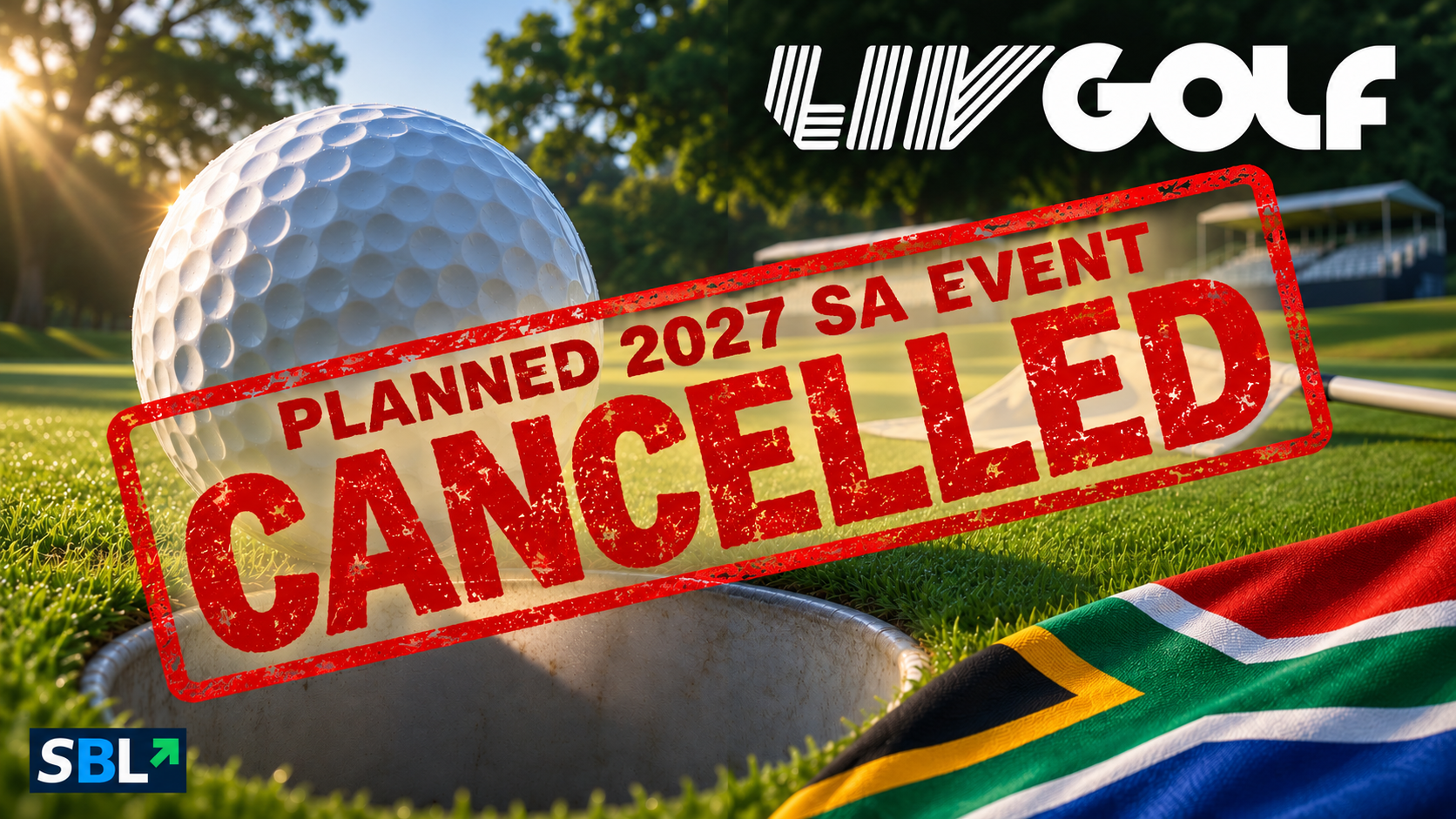
LIV Golf’s shutdown ends its planned South African return in April 2027. Its inaugural Steyn City event went ahead in March 2026, with the government reportedly paying R82.17 million for the licence.
LIV Golf is heading towards liquidation, not simply pausing its season. Front Office Sports reported on 10 November that the league had filed a Chapter 11 liquidation plan that day. It reported a disclosure-statement hearing set for 24 November and a plan-confirmation hearing scheduled for 7 January 2027. These are proposed steps in the court process, not proof that liquidation has been completed. SBL has not independently retrieved the filed plan or verified a court approval order. Front Office Sports report.
This follows the failure of LIV’s proposed restructuring transaction. The league’s official statement says it remains open to third-party alternatives during the closure process. That does not restore the cancelled planned South African return or establish that a successor event will happen. LIV Golf statement.
What happened to the South African return?
In March 2026, LIV announced that a second South African tournament would take place at Steyn City on 22–25 April 2027. It also announced an early-bird ticket-sale window from 22 to 29 March 2026 for that 2027 event. March 2026 announcement.
Current context: This historical announcement records what had been planned, not confirmation that it will happen.
The inaugural event took place on 19–22 March 2026, according to Newsday’s report of the minister’s parliamentary answer cited below. That was this year, not last year.
IOL reported on 6 November that Southern Guards GC had confirmed the end of its involvement following the league’s collapse, ruling out the planned South African return. Its report quoted team general manager Richard Glover thanking local fans and partners. SBL has not independently obtained that team statement. IOL report.
How much public money was involved?
The reported licence payment and projected economic impact should not be treated as the same thing. Tap or click each heading to expand the explanation.
▸ R82.17 million: the reported licence payment
Newsday’s 19 October report of a parliamentary answer says Sport, Arts and Culture Minister Gayton McKenzie’s department paid US$5 million, reported as R82,166,500, to LIV Golf Events for the inaugural South African tournament held in March 2026, not the planned 2027 return. It described a Treasury-approved transfer between budget allocations. This was departmental public money, not McKenzie’s personal payment, and the licence fee was separate from staging costs. SBL has not independently retrieved the original written answer or payment record. Newsday report.
▸ R500–800 million: a projection, not cash returned to government
Before the event, Cabinet cited expected direct economic impact of R500–800 million per event. Cabinet statement.
SBL analysis: This was a forecast of activity, not a verified return to the fiscus or an audited profit. It cannot simply be subtracted from the licence fee to declare a taxpayer gain.
The value-for-money test
SBL analysis: The central comparison is not a licence fee against a headline economic-impact estimate. A credible assessment needs total public support, independently verified additional visitor spending, local supplier payments and measurable community benefits, with the assumptions and overlap explained.
A lost future event does not prove the March tournament delivered no benefit. Equally, a well-attended tournament does not by itself demonstrate that public funding produced a worthwhile return. Those are questions for evidence, not rival slogans.
According to Newsday’s account of the minister’s answer, a signed-off close-out report is due to Parliament by 22 November, separating verified benefits from projected impact. The report also said the event’s GSIQ impact study was commissioned by LIV, not an independent pre-event assessment commissioned by the department. The proposed report is the next accountability document to watch; its promised submission is not evidence that it has already been delivered.
Four questions the close-out report should answer
SBL analysis: Readers can use this checklist to judge the evidence when it appears, rather than compare two incompatible headline amounts.
- What was authorised, and what was paid? A budget allocation is permission to spend, not proof of a payment. Reconcile the reported licence fee with actual departmental expenditure and any other public support.
- What did the money buy? Separate the licence from event production, security, transport and other hosting costs. The reported licence fee alone cannot establish the total cost to taxpayers.
- What was genuinely additional? Show spending brought into the economy by the event, rather than counting all activity around it or counting the same spending twice. Explain the method and who commissioned the assessment.
- Which benefits were delivered? Distinguish measured supplier income and community benefits from forecasts. A projection of economic activity is not government revenue or an audited financial return.
What fans should check before spending more
Do not treat an older ticket page or the original April dates as fresh confirmation. If you already bought tickets or hospitality, keep the purchase record and request a written status update from the seller. Check accommodation and travel cancellation terms separately before making further commitments.
SBL has not verified how many 2027 tickets were purchased, a current South Africa-specific refund timetable or a confirmed replacement event. We therefore cannot promise a refund date, automatic reimbursement or that tickets would transfer to a successor.
The bottom line: The planned return is no longer something fans should budget around as confirmed. The public-money question requires separating the reported licence payment, total hosting costs and measured benefits. A reported payment is not a complete event budget, and a forecast is not a verified result.
Leave a Reply