
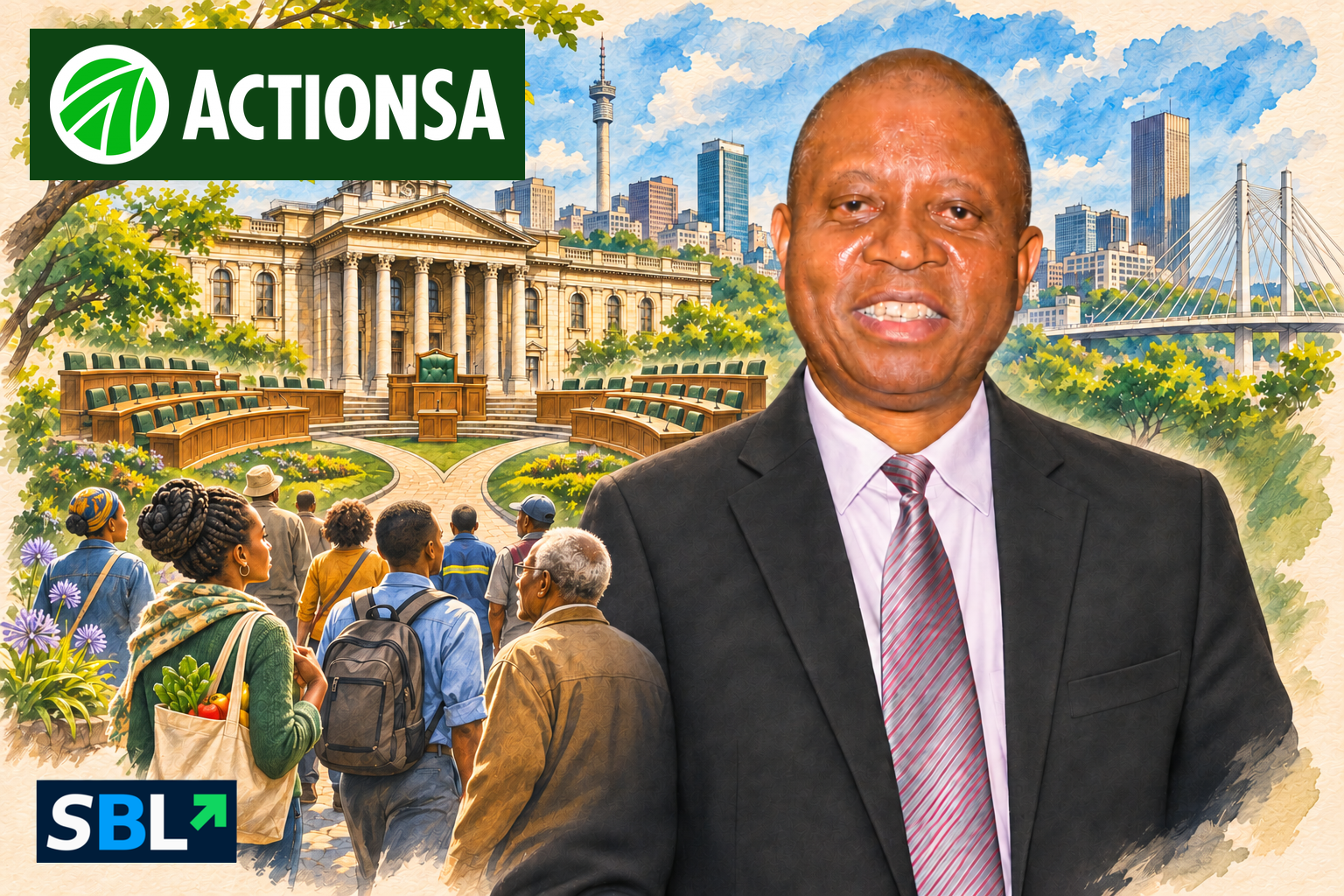
Image: Editorial illustration based on an archival US Embassy photograph of Herman Mashaba; the citizens and council scene are symbolic. ActionSA logo used for identification; no endorsement implied.
SBL ANALYSIS
Herman Mashaba says ActionSA will not be bullied into a coalition. His latest statement has prompted a pointed debate beneath his Facebook post: should disagreements with particular leaders stand in the way of cooperation with the DA? The answer requires separating what he has proposed, what commenters believe and what residents would actually gain.
Prepared and last checked: 14 November 2026. This article distinguishes reported facts, public comments and SBL analysis.
What is new
In his 14 November statement, Mashaba defended ActionSA’s independence and described past political disagreements and perceived disrespect. He also advanced a governing argument, pointing to the ActionSA-led coalition in Tshwane. These are his stated reasons, not proof of his underlying motives.
This moves beyond the uncertainty examined in SBL’s 8 November report. A subsequent proposal and meeting have made the choices more concrete.
He offered to step aside too
EWN reported on 10 November that Mashaba offered to withdraw from Johannesburg’s mayoral race if Helen Zille did the same, allowing ActionSA to support another DA candidate. ActionSA chairperson Michael Beaumont confirmed the letter’s authenticity, according to EWN.
This matters. It challenges the suggestion that he simply insists on the mayoralty for himself. It does not settle whether rejecting Zille benefits residents. But saying he refuses to work with the DA altogether would misrepresent the proposal.
IOL’s 13 November report records his meeting with DA leader Geordin Hill-Lewis on 12 November. It also describes proposed Tshwane conditions involving Cilliers Brink relinquishing his council seat and DA support for Nasiphi Moya. These are reported negotiating positions, not a confirmed governing agreement.
The comments are divided, not a public mandate
SBL inspected the public Facebook post on 14 November. Several prominent comments urged DA–ActionSA cooperation and warned against personal ambitions or emotions outweighing residents’ interests. Some wanted the ANC kept out of government.
There was dissent too: one self-described ActionSA voter supported whichever coalition Mashaba chose and rejected any obligation to partner with the DA.
This was a limited reading under Facebook’s “Most relevant” setting, not a representative survey. Voting histories were not verified. The comments establish disagreement on that page, not what all voters believe. They cannot prove private financial interests or self-dealing.
The SBL test: what does each choice deliver?
A different mayoral candidate could unlock stable government. It could also consume negotiating time without improving services. The difference lies in the agreement that follows.
Explore option 1: both Johannesburg candidates step aside
▼ Tap or click to expand or close
The potential gain is a compromise candidate acceptable to both parties. What remains unanswered: who would that be, would sufficient councillors support them, and which funded service commitments would they implement? Removing two names does not answer those questions.
Explore option 2: parties retain their preferred candidates
▼ Tap or click to expand or close
They preserve their leadership choices but still need sufficient council support. Residents should not assume that the largest vote share means an outright majority or an automatic right to govern alone.
Explore option 3: ActionSA chooses different partners
▼ Tap or click to expand or close
Party independence permits alternative negotiations. The accountability test stays the same: what will that coalition deliver differently, how will it pay, and how will residents measure results? Partner names are not a service-delivery plan.
His performance argument deserves scrutiny too
There is independent support for part of the Tshwane financial-improvement argument. On 3 April 2025, Parliament’s cooperative governance committee welcomed progress in stabilising finances, including a fully funded budget and reduced Eskom debt.
That historical statement is not a current comprehensive service-delivery audit. It also does not establish that one party alone deserves credit. It supports examining measurable performance, not granting any coalition a blank cheque.
What residents should demand next
- A public agreement: clear responsibilities, priorities and a dispute-resolution process.
- Costed commitments: which water, electricity, road and billing problems will be addressed, using which budget?
- A delivery baseline: current performance, deadlines and public progress reports.
Households and businesses need predictable services and credible bills. A successful statement or popular comment is not evidence that a coalition can deliver them.
SBL bottom line
It is reasonable to question whether political grievances shape Mashaba’s conditions. It is not established that he is pursuing private interests. His offer to withdraw matters, and his governance claims deserve scrutiny. The fair test for ActionSA, the DA and every prospective partner is whether their conditions produce a funded, accountable government that works for residents.
Sources and limitations
Sources linked above: ActionSA, 14 November 2026; EWN, 10 November; IOL, 13 November; Parliament, 3 April 2025; public Facebook post and selected visible comments inspected 14 November. ActionSA’s statement was cross-checked against contemporary reproductions. No interviews were conducted. No final coalition agreement, complete comment census or current independent comparison of municipal performance was established. The choice panels are SBL analysis, not predictions.
Leave a Reply