
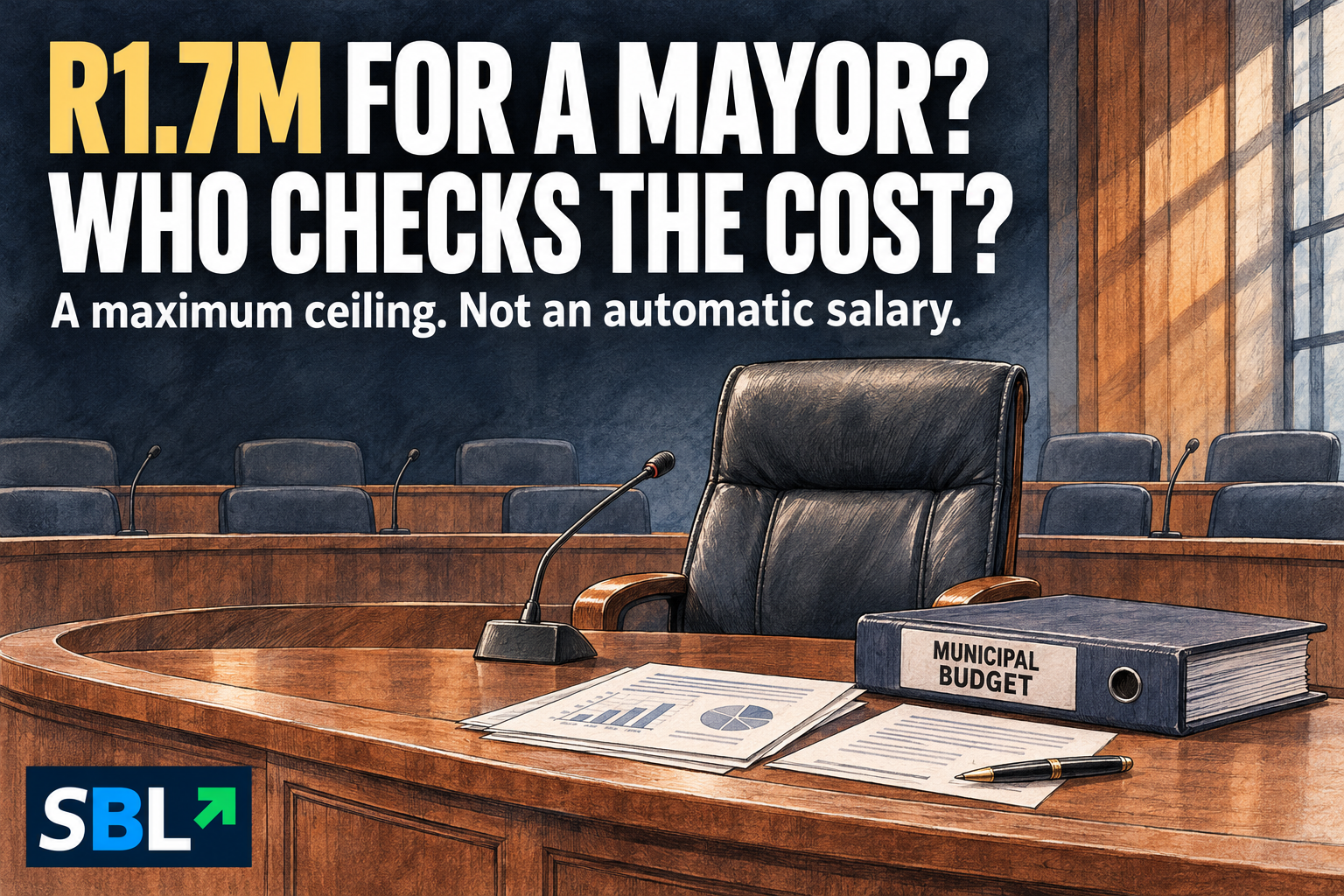
A R1.7 million mayoral package is an arresting number. The more useful question for ratepayers is who decides whether their council can afford it.
New municipal councillor pay limits, published on 17 November in Government Gazette 55749, put the annual total remuneration ceiling for a full-time mayor in a grade-six municipality at R1,716,041. The notice does not establish that any particular mayor receives that amount.
The council still has to make a decision
The schedule’s preamble requires a resolution supported by a majority of council members, with the provincial local-government MEC’s concurrence before implementation. Councils must consider affordability and Cabinet-approved austerity measures when determining remuneration within the limits.
That makes the local decision worth examining. A national ceiling tells residents the permitted maximum for a category. The council resolution should establish what their municipality has actually approved.
Which municipality, which job, which package?
The notice grades councils using a points system combining municipal income and population. It is not a service-delivery score. Different limits apply to different offices and to full-time and part-time councillors.
For full-time mayors, the published annual package ceiling ranges from R956,323 in grade one to R1,716,041 in grade six. A grade-six speaker or deputy mayor has a R1,385,901 ceiling. The corresponding limit for a mayoral-committee member, whip or subcouncil chair is R1,305,503.
These are total remuneration packages, not take-home salaries. The definition includes basic salary, specified vehicle and housing allowances, and municipal pension and medical-aid contributions. Separately permitted expenses and allowances should not be confused with those components.
Published in November, effective from July
The notice takes effect from 1 July 2026 and replaces the determination published on 20 February. Publication and commencement are therefore different dates. That does not establish a payment date or the amount of any adjustment for an individual councillor.
This is also separate from the national and provincial office-bearer pay increases SBL reported earlier.
Three questions ratepayers can ask
- What grade has the municipality used, and what evidence supports that classification?
- What remuneration did the council approve, and where are the resolution and MEC concurrence?
- How did the municipality assess affordability, including the wider cost of allowances?
Those questions turn a national salary headline into local accountability. Neither the Gazette nor this report establishes that a specific council has breached the rules. Assessing that would require its records and response.
Source
Government Gazette 55749, Notice 8194, 17 November 2026: preamble; definitions; items 2–5, 8–13 and 19–20. Alternative copy of the same Gazette.

Leave a Reply