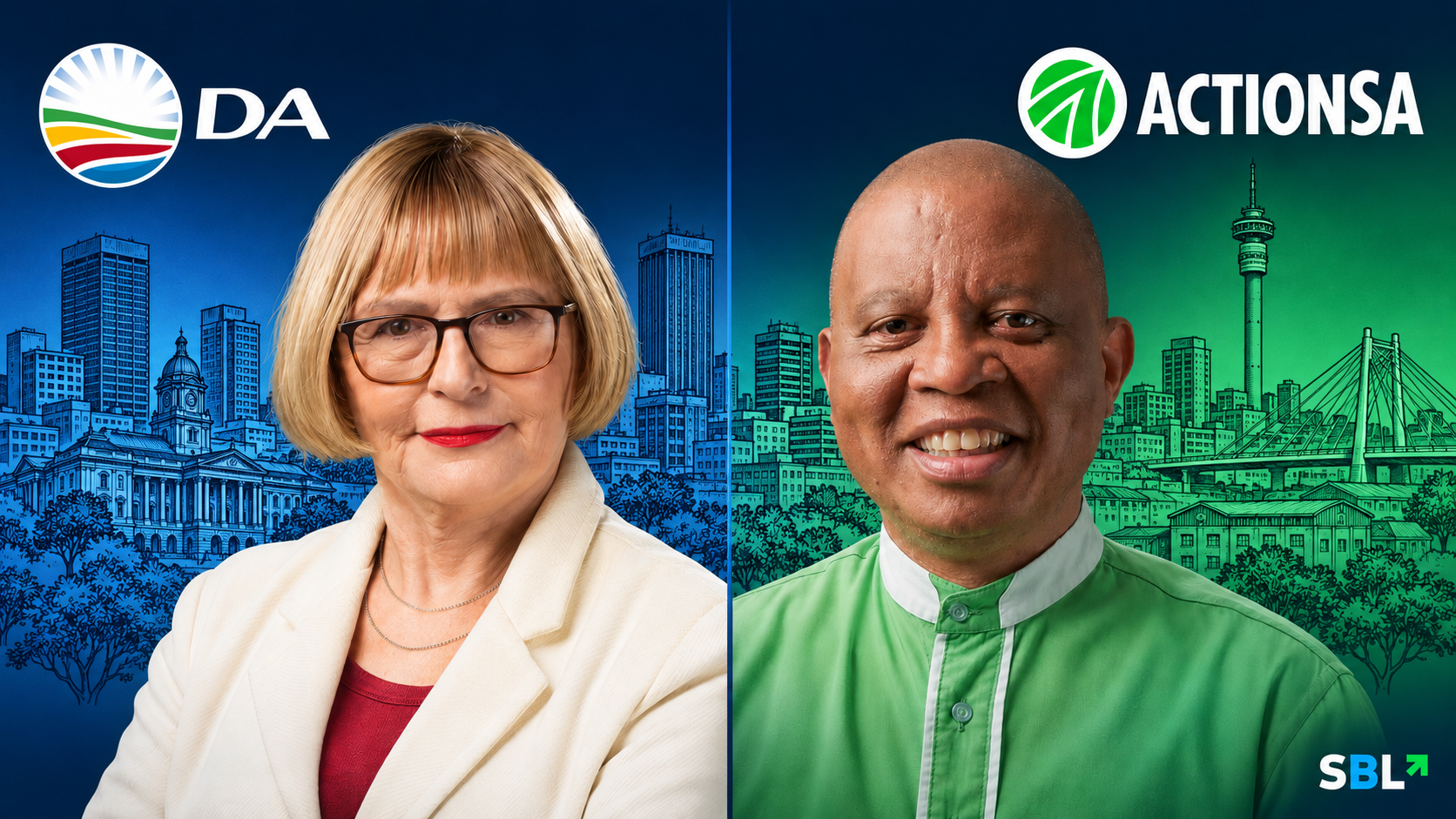
Helen Zille and Herman Mashaba both want to lead Johannesburg, but their parties face a serious trust problem. The Democratic Alliance has authorised coalition talks while Mashaba has publicly played down a deal with it. ANC involvement remains a possibility, but neither a new governing agreement nor a winning mayor is established by the evidence reviewed.
SBL analysis. Prepared and last checked: 8 November 2026, before the planned 18:00 SAST national results announcement.
Key findings
- The DA has authorised nationally coordinated coalition negotiations.
- Mashaba has described a DA coalition as unlikely while keeping negotiations open.
- Reports of an effort to block Zille are contested, not confirmation of an agreed ActionSA decision.
- Verified council seats and formal agreements are needed before naming a likely governing coalition.
What has changed?
Campaigning has given way to choosing governing partners. In an official statement dated 7 November, DA Federal Council chairperson Ashor Sarupen said the party’s Federal Executive had authorised discussions in municipalities without outright majorities.
The stated conditions include accountable government, service delivery, the rule of law and non-racialism. Negotiations will be coordinated nationally. The statement does not announce a partner or mayor.
ActionSA’s public position combines resistance with flexibility. In a Sunday Times interview published on 8 November, Mashaba described the chances of a DA coalition as “Very slim. Very, very slim.”
He also said his party was not closing the door to any party and was considering different scenarios, including opposition. The interview refers to Friday’s results, so these remarks should not be mistaken for a decision taken on Sunday.
Has ActionSA blocked Zille?
No confirmed agreement reviewed for this article establishes that.
The Sunday Times report published on 8 November described resistance to a Zille mayoralty, including claims from an unnamed ActionSA source. In the same report, named national chairperson Michael Beaumont kept open an arrangement involving the DA and Zille, while expressing concerns.
The Citizen reported on 8 November that Mashaba disputed the anonymous-source claims. These are contested negotiating positions, not a council decision.
The friction predates the count. ActionSA’s 29 October statement launched a campaign against Zille. That establishes a public political disagreement; its allegations are party claims, not findings adopted by SBL.
SBL analysis: what is the most likely outcome?
The best-supported expectation is difficult negotiations, rather than a quick, straightforward DA–ActionSA agreement. The evidence reviewed does not establish a reliable favourite for Johannesburg’s mayoralty or governing coalition.
Mashaba’s public scepticism creates a substantial political hurdle. It does not establish which alternative can win enough councillor support. Without verified final seats and commitments from potential partners, ranking an ANC-backed arrangement above a DA–ActionSA deal would go beyond the evidence.
A DA–ActionSA agreement remains possible if both parties compromise. Daily Maverick’s article dated 6 November, containing subsequent developments, reported that Beaumont’s negotiating priorities include service delivery, fighting corruption and stable leadership. Those priorities overlap with parts of the DA’s mandate, but shared language does not establish agreement on budgets or personnel.
This is a cautious, low-confidence assessment of the negotiating path. It is not a numerical forecast or a prediction that one candidate will win.
Three conditional routes to watch
DA and ActionSA: An agreement would require a settlement on leadership and working arrangements, plus enough councillor support. SBL has not independently verified whether these two parties alone meet that threshold.
DA with ANC involvement: A coalition or outside support is a scenario to examine if other talks stall. Its feasibility depends on verified seats and party decisions. No such agreement is confirmed in the evidence reviewed.
ActionSA with the ANC and potentially other partners: Another conditional route, requiring sufficient support and agreement on leadership and spending. It cannot be ranked as the favourite from the material verified here.
These scenarios are not an exhaustive list or completed deals. A party can also choose opposition. National cooperation does not automatically settle local negotiations.
What residents and businesses should demand
The practical test is whether the next government can fund and implement its commitments. Section 160 of the Constitution requires a supporting majority of the council’s members for budgets, rates and other taxes, by-laws and loans. Support outside the executive can therefore matter to essential decisions.
SBL’s recommendation is to judge any deal against a published service plan, named responsibilities, affordable spending commitments and a clear process for resolving disagreements.
Households should look for what the agreement means for municipal bills, water, electricity and basic services. Businesses need dependable infrastructure and predictable decisions. A mayoral announcement alone cannot demonstrate either.
The potential benefit of a workable agreement is more predictable decision-making. The risks include unfunded promises, disputes that interrupt council business and compromises that obscure responsibility. No financial saving or service improvement can yet be calculated from an agreement that has not been verified.
Limits and what happens next
SBL has not verified final metro seat allocations directly from the Electoral Commission’s results dashboard, which was inaccessible to our research tool. Conflicting third-party snapshots were excluded. We have not calculated coalition majorities or assigned probabilities to candidates.
In a 7 November briefing reported by SAnews, the IEC said it planned to announce national results at 18:00 SAST on 8 November. It also explained that upheld objections can lead to changes after declaration.
The next checks are verified council allocations, formal party announcements, written coalition agreements and council proceedings. Party positions may change as bargaining continues.
Related reading: SBL’s 6 November provisional metro standings. That snapshot is not a current results table. Our earlier Johannesburg mayoral-debate coverage provides campaign context, rather than evidence of a post-election deal.
SBL bottom line
A DA–ActionSA deal faces a clear trust hurdle, but remains possible. It is too early to name Zille, Mashaba or another candidate as the likely winner on the verified evidence available. The decisive test is a workable council majority tied to a funded governing agreement.
Sources and methodology
This analysis separates official party positions, attributed interviews, contested reporting and SBL’s conditional assessment. Source publication dates and the interview’s earlier reference period are identified above. The constitutional source displays its text as at 7 May 2026.
No polling model, unpublished negotiation information, invented probability or estimated seat allocation was used. Scenarios illustrate conditions that would need to be met; they are not calculated outcomes. Results status and party positions require a fresh check immediately before publication.
Image: Editorial composite created for SBL. This is not a photograph of a joint appearance.
Leave a Reply