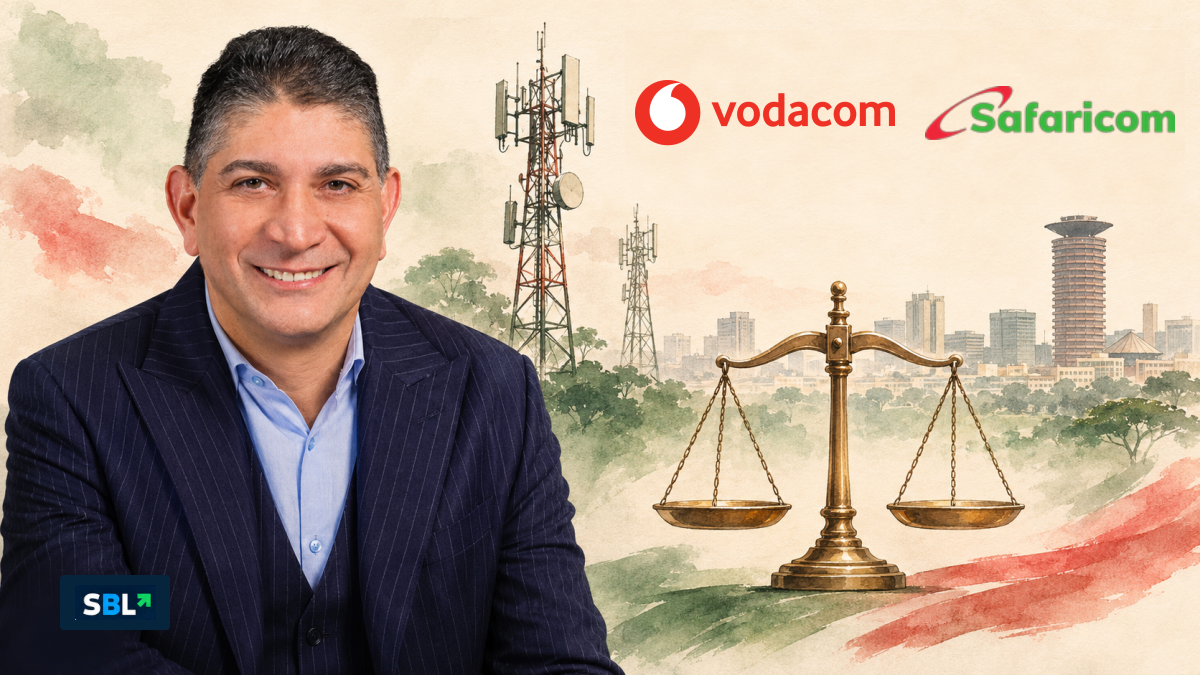
Editorial composite: SBL. Portrait reference: Vodacom.
Vodacom has secured lender waivers after a Kenyan court ruling triggered default clauses in some of its loans. But the bigger question remains unresolved: will it keep the Safaricom stake that helped lift its latest results?
The group’s interim results for the six months to 30 September 2026 disclose that the court judgment caused defaults and cross-defaults under certain funding agreements. Vodacom says it obtained waivers after the reporting date for all defaults arising solely from that judgment.
This is a disclosure about contractual triggers caused by a legal ruling, rather than a statement that Vodacom failed to make scheduled loan payments. The waivers address those funding defaults. They do not settle the ownership dispute.
Why the shares are still with Vodacom
Vodacom completed transactions on 30 June that increased its effective interest in Safaricom from 35% to 55%. The additional effective holding comprised 15% acquired from the Kenyan government and about 5% from Vodafone.
On 15 September, Kenya’s High Court nullified the government’s 15% sale. An appeal followed. In its 16 October stock-exchange announcement, Vodacom said the Court of Appeal had directed that the existing position on the shares and purchase money be maintained while the appeal is heard.
That leaves Vodafone Kenya, the acquisition vehicle, as the registered holder of the disputed shares for now. It is a temporary position while the case proceeds, not a final victory for Vodacom.
What changed in the accounts
The loan disclosures show how a court battle can affect a company before the final outcome is known. At 30 September, some lender undertakings did not give Vodacom an unconditional right to postpone repayment for at least 12 months. It therefore moved R2.304 billion of debt from non-current to current liabilities.
That is a change in how existing debt is classified, not R2.304 billion of new borrowing. The results say the position was subsequently remedied through the waivers. TechCentral’s 10 November report also examined the funding consequences of the ruling.
Meanwhile, Vodacom continues to consolidate Safaricom as a subsidiary. Group revenue rose 25.6% to R102.5 billion in the half-year, reflecting the inclusion of Safaricom from the second quarter. Readers should therefore distinguish growth helped by bringing another business into the accounts from growth on a comparable basis.
For service revenue, Vodacom reports 29.4% growth, compared with 13.3% on its pro-forma measure that includes Safaricom in the comparative period. Those figures describe different comparisons; they should not be treated as interchangeable.
The next decision to watch
In the results, Vodacom says it expects an appeal date to be set before the end of December 2026. That is an expectation about scheduling, not a confirmed deadline for a final judgment. ITWeb reported on 11 November that CEO Shameel Joosub expected the appeal to be heard in the coming weeks and remained confident in Vodacom’s position.
The company’s formal accounting note is more cautious about the outcome: if the appeal fails, it will reassess the implications for its accounts. The 15-percentage-point government stake is central to that uncertainty; it is not the whole 55% holding.
For South African investors, there are two separate developments to follow: the lender waivers have dealt with defaults arising solely from the judgment, while the appeal will determine the fate of the disputed acquisition. Stronger operating results do not remove that legal risk.
Related reading: MTN is growing across Africa. Why is its South African revenue flat?

Leave a Reply