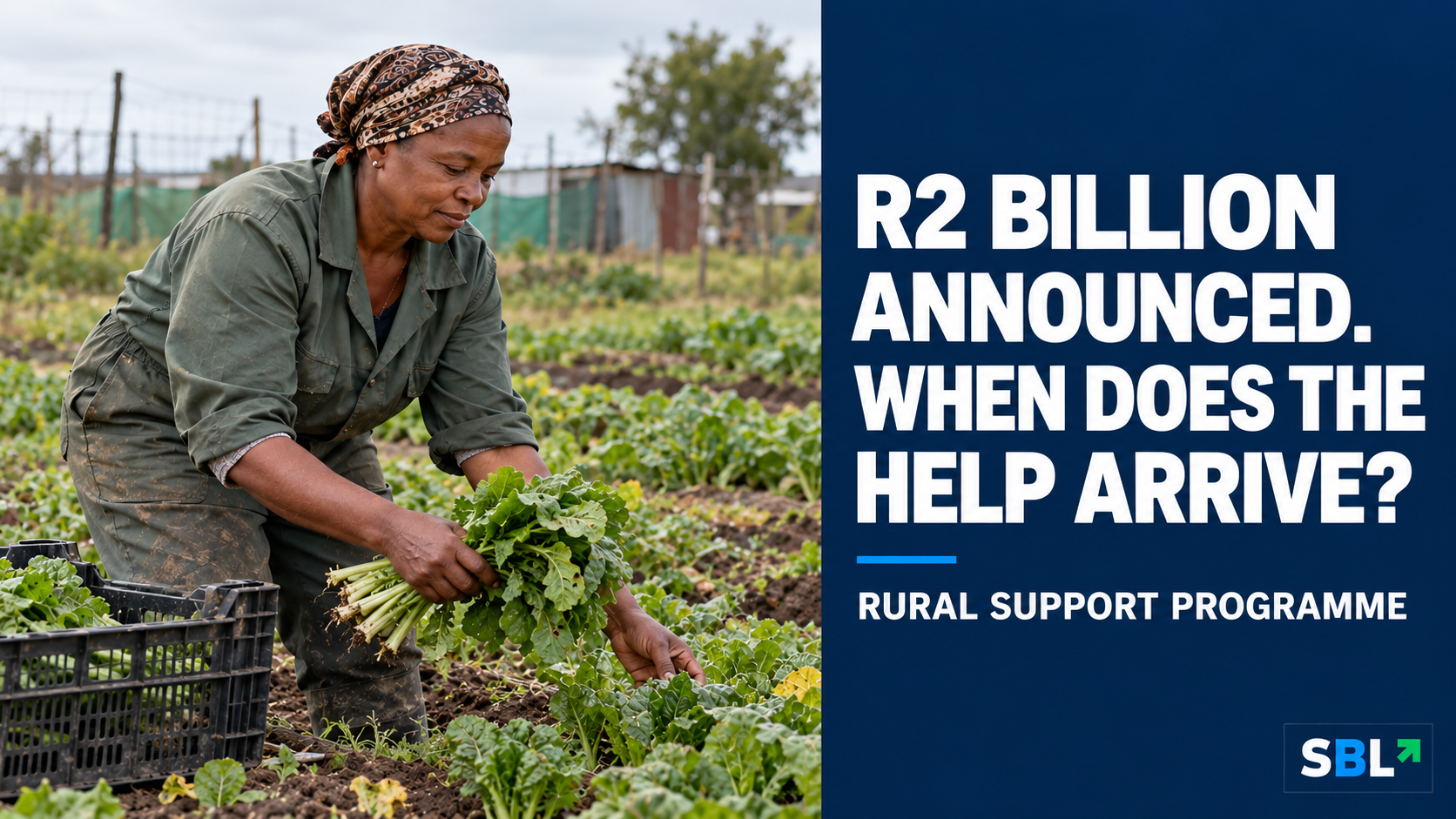
September applications are under review. For rural households and enterprises, the next test is what support is approved, on what terms and when it arrives.
South Africa’s R2 billion Integrated Land Reform and Rural Development Support Programme has moved into its launch phase, with R1.2 billion allocated for the current financial year. The immediate question for applicants is when an allocation becomes usable support.
Land Reform and Rural Development Minister Mzwanele Nyhontso launched the programme at Nywarha Village in the Eastern Cape on 26 October. The department’s statement, published on 27 October, says September submissions and infrastructure assessments are being evaluated. Departmental launch statement
The application window came before the launch
The first call ran from 3 to 30 September 2026, according to George Municipality’s 8 September notice. It covered the 2026/27 and 2027/28 financial years. That notice required screening, verification and due diligence, and warned that applying did not guarantee approval.
Readers should not treat this week’s launch as a fresh invitation to apply. The sources reviewed do not establish a reopened window or an extension. Anyone who missed the September call should seek an official update before relying on an old application link.
Who the support is intended to reach
The September notice lists rural households, subsistence and smallholder farmers, communal producers, land reform beneficiaries, co-operatives, agri-SMMEs and qualifying projects among potential applicants. It calls for documents appropriate to the category, including proof of land access and, where applicable, business, governance and compliance records.
The launch statement describes combined finance, technical help, infrastructure, skills and market access. It says the current-year allocation spans all nine provinces, with provincial amounts from R100 million to R170 million.
What an applicant needs beyond the headline amount
SBL analysis: A producer planning a planting cycle needs an answer about timing as well as value. Equipment, inputs or infrastructure can only support a production plan if the recipient knows what has been approved and when it will be available. A large national allocation cannot answer those project-level questions.
Applicants following up on an existing submission can make the discussion more useful by asking:
- Has the application passed verification, and is anything still missing?
- What support has been approved in writing, rather than requested?
- Will assistance take the form of goods, services or finance, and what conditions apply?
- Who is responsible for delivery, and what date can the project plan around?
- Which costs or responsibilities remain with the beneficiary?
Keep the original submission, reference details and subsequent correspondence together. These questions are a planning checklist, not additional official eligibility rules. Applicants should confirm their own terms through the department rather than assume every category receives the same package.
The delivery test
Future reporting should separate applications received, approvals issued, support delivered and productive results. Each measures a different stage. An approval count can show administrative progress; it does not by itself show that equipment is working, a facility is operating or a business has secured customers.
The launch statement does not provide a programme-wide disbursement total, a count of successful applicants or a dated delivery schedule for each project. That is a limit of the published evidence, not proof that no support has reached anyone. Those figures would help readers judge whether the programme is moving from an announced budget to useful assistance.
Leave a Reply