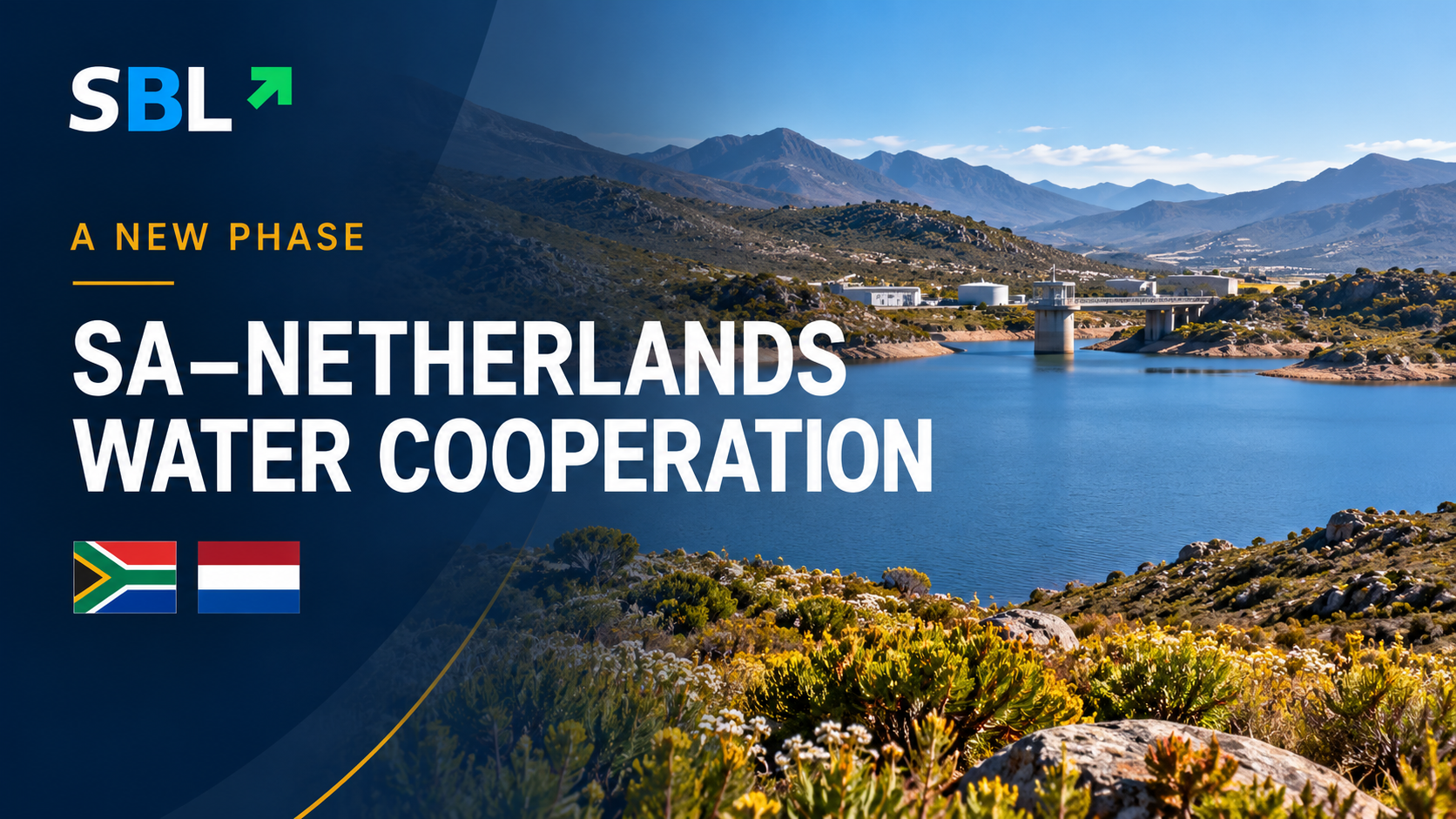
South Africa’s water partnership with the Netherlands is preparing for its next phase, with catchment management agencies set to receive support on planning, governance and information systems.
The new step is a declaration of intent signed in Cape Town on 29 October by Water and Sanitation director-general Dr Sean Phillips and Dutch Water Authorities president Jeroen Haan. SAnews reported the signing on 30 October.
The key facts
- Phase III is intended to cover 2027 to 2030.
- The programme’s strategic direction was endorsed on 7 October.
- Proposed work packages are being consolidated for a multi-year implementation plan.
- The priorities are financially and organisationally stronger agencies, catchment strategies, better data systems and broader participation.
These are commitments to develop the next stage of cooperation. They should not be read as evidence that every local project, budget or delivery deadline has already been settled.
What the cooperation is designed to do
The emphasis is on helping South African institutions make and carry out better decisions about water resources. The announcement says skills and systems should remain embedded locally, rather than depend on a succession of outside interventions. Each agency will shape objectives around its own circumstances.
This is not a new bilateral relationship. The countries’ October 2023 joint communiqué recorded a renewed water memorandum signed that March. It described Blue Deal’s ambition to help improve access to clean, safe and sufficient water for 2.5 million South Africans by 2030. That was a programme goal, not a count of people already reached or a new commitment announced this week.
SBL analysis: why it matters
For businesses, the potential value lies in more dependable planning and clearer information about the water resources on which operations depend. Better monitoring could help identify problems earlier, while participation could give local water users a stronger voice in priorities. Those are possible benefits of the proposed approach, not measured results of this signing.
For residents, there is an important distinction between managing a catchment and running a municipal supply network. In its published explanation of responsibilities, the water ministry distinguishes national resource management from municipalities’ responsibility for local water and sanitation services.
Stronger catchment institutions can support the wider system. They do not, by themselves, repair a broken pipe, operate a treatment plant or confirm that a particular neighbourhood’s supply is safe. Residents and business owners should continue to rely on the relevant local authority’s notices for service interruptions and restoration updates.
The declaration should therefore not be treated as a reason to drop contingency planning, assume lower water costs or expect a procurement opportunity. The SAnews account does not announce a construction allocation, tender or household restoration date.
What to watch next
The next test is how the multi-year plan turns the priorities into named activities, responsibilities and support for individual agencies. Useful evidence would include funded work programmes, public milestones and reporting that shows whether monitoring and management actually improve.
That is a different story from the municipal leaks and billing weaknesses examined in SBL’s Gauteng water-loss report. The partnership concerns the capacity behind water-resource decisions. Its eventual value will depend on implementation, not the signing alone.
Leave a Reply