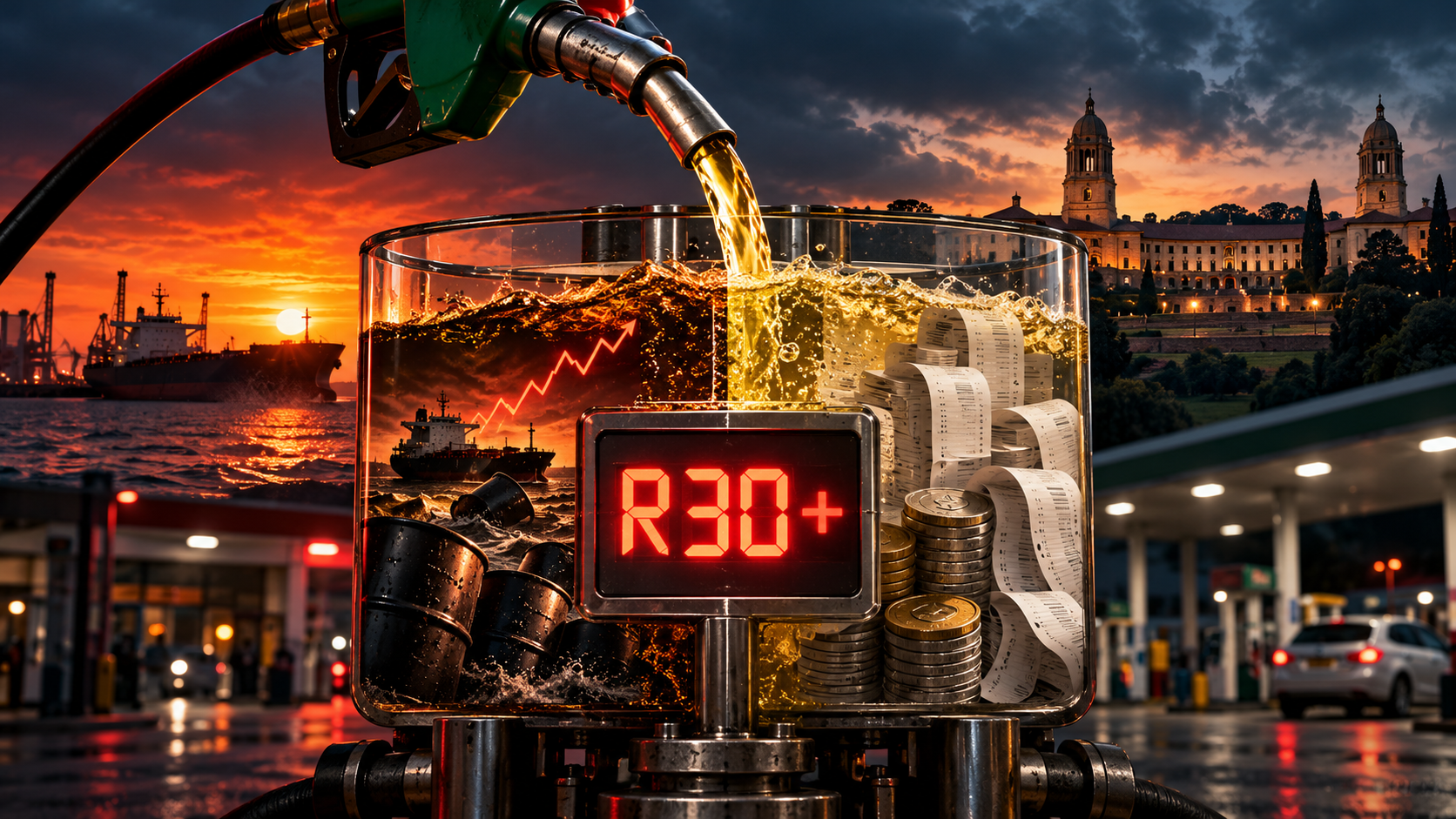
Petrol has climbed above R30 a litre in inland South Africa, reviving a familiar argument: is government responsible for what motorists pay at the pump?
The short answer is that government taxes and regulated charges make petrol significantly more expensive—but they did not cause most of October’s increase.
From 7 October 2026, 95 unleaded petrol costs R30.25 a litre in Gauteng and R29.38 at the coast. Inland 93 petrol costs R29.88, while the coastal price is R29.01. That followed increases of R3.33 a litre for 95 petrol and R3.12 for 93 petrol.
What caused October’s jump?
The biggest factor was the international price of oil and refined fuel.
According to the Department of Mineral and Petroleum Resources, average Brent crude rose from $87.89 to $101 a barrel during the review period. The department attributed the increase to US-Iran tensions, uncertainty over oil flows through the Strait of Hormuz, higher shipping costs and declining inventories.
International petrol-product prices added about R3.29 a litre to the Basic Fuel Price. By comparison, the rand was almost unchanged, averaging R16.212 to the dollar against R16.213 previously. Its contribution reduced the calculated petrol price by less than one cent a litre.
This matters because South Africa prices fuel on an import-parity basis. The benchmark reflects what it would cost to buy refined product on international markets and deliver it to South African ports—even when some fuel is produced locally.
How much does government take?
Government-controlled taxes are a substantial part of every litre.
For petrol in the 2026/27 financial year, the general fuel levy is R4.10 a litre, the Road Accident Fund levy is R2.25, the carbon fuel levy is 19 cents and customs and excise add about four cents. Together, these direct taxes total roughly R6.58 a litre.
At Gauteng’s R30.25 price for 95 petrol, that is about 22% of the pump price. Put differently, removing every one of those taxes would reduce the price sharply—but petrol would still cost close to R24 a litre before considering changes elsewhere in the formula.
The government also controls the pricing system and regulates petrol margins and transport-zone adjustments. A slate levy of 87.66 cents a litre is currently included to compensate the industry for past under-recoveries when regulated prices did not fully match calculated costs.
So is government to blame?
Partly—but saying the petrol price is high only because of government is misleading.
Government decides the levies, maintains the import-parity formula, regulates petrol margins and determines how monthly movements are passed on. Those decisions add several rand to every litre and are legitimate subjects for public scrutiny.
However, government does not set the global oil price, international refining margins or shipping costs. It also cannot fully control the rand-dollar exchange rate. In October, these external costs—not a new tax increase—were the main reason motorists faced such a steep monthly jump.
There is also a trade-off when calls are made to cut levies. The general fuel levy supports the national budget, while the RAF levy funds compensation for road-accident victims. Cutting them can lower pump prices, but the lost revenue must be replaced, spending must fall, or government borrowing must rise.
The real answer
South Africa’s petrol price is high because several pressures stack on top of one another: expensive global oil, imported-product and shipping costs, the rand exchange rate, taxes, the slate levy, regulated industry margins and inland transport costs.
Government controls an important part of that total, but not the largest driver of October’s surge. The fairest conclusion is that motorists are paying for both international energy shocks and domestic policy choices—not one or the other.
Sources: Department of Mineral and Petroleum Resources, October 2026 fuel adjustment; DMPR fuel-price structure; and National Treasury 2026 Budget Review.

Leave a Reply