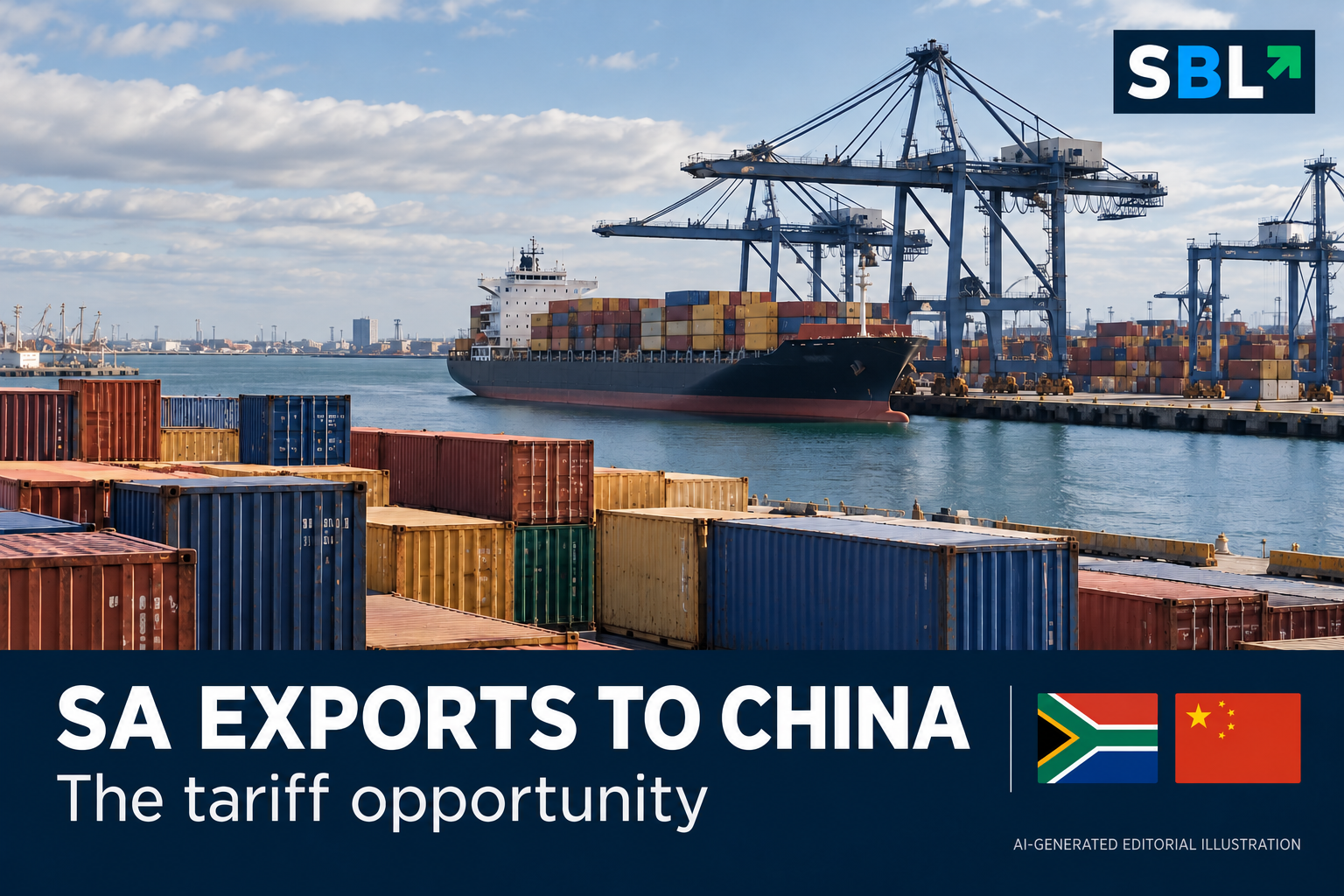
China’s zero-tariff offer gives qualifying South African exporters a chance to compete on better terms. But the test is whether easier market access produces repeat orders and local production, not simply more customs paperwork.
Prepared, checked and published: 22 October 2026.
South Africa is seeking longer-term certainty for exporters using China’s temporary zero-tariff scheme, Trade, Industry and Competition Minister Parks Tau said at a briefing in Pretoria on Thursday, 22 October.
The new development is an update on implementation and negotiations, not the launch of duty-free access. The arrangement began on 1 May 2026 and runs until 30 April 2028, according to China’s Customs Tariff Commission announcement.
SAnews’ report of the briefing says SARS issued 25,975 certificates of origin between 1 June and 31 August. It also reports that officials are negotiating an Early Harvest Agreement through the Southern African Customs Union, aimed at giving exporters certainty beyond 2028. That agreement is not yet a concluded replacement for the current scheme.
The opportunity, and the gap it must help close
The historical figures reported at the briefing show why selling more into China matters. Imports grew much faster than exports between 2021 and 2025. These are earlier trade figures, not evidence of what the scheme launched in May has achieved.
| Measure | 2021 R billion |
2025 R billion |
|---|---|---|
| SA exports to China | 198 | 222 |
| SA imports from China | 284 | 420 |
| Trade deficit, calculated | 86 | 198 |
SBL analysis: A bilateral deficit is not, by itself, proof that trade harms South Africa. Imported equipment and inputs can support local businesses. The useful question is whether improved access enables South African producers to win additional, profitable business rather than simply increasing the volume of trade in either direction.
Zero tariff does not mean zero conditions
The DTIC’s 1 May announcement makes eligibility conditional on the applicable tariff schedule, product-specific origin requirements and a valid certificate of origin. Being shipped from South Africa is not, on its own, the same as qualifying as South African-origin goods.
There is also an important quota qualification. China’s published tariff annex states that, for goods under tariff-quota administration, only the in-quota rate falls to zero. Out-of-quota rates remain unchanged. Exporters should therefore check their exact product classification and quota position rather than assume the headline applies without limits.
SARS guidance, updated on 13 August, also clarifies that eligibility from the start date depends on clearance through Chinese customs, not the date of shipment from South Africa. It provides for retrospective certificates subject to the rules, and requires records to be retained for five years.
Where South Africans could benefit
SBL analysis: The commercial benefit depends on who keeps the tariff saving. A producer could use it to offer a more competitive delivered price, protect its margin or negotiate a larger order. It should not assume that the entire saving becomes extra profit: the buyer’s bargaining position and competing suppliers still matter.
Established exporters with suitable products and documentation may be better placed to act quickly. Smaller businesses face a different test: whether the likely orders justify certification, marketing and delivery costs. Workers and local suppliers could benefit if sustained demand leads to more production, but certificates alone do not establish that jobs have been created.
Standards remain another practical hurdle. In a 30 June statement on regulatory cooperation, the DTIC identified duplicate testing, standards comparisons and acceptance of accredited results as areas needing work. Tariff relief does not itself solve those problems.
What to watch next
The immediate watchpoints are a published outcome from the Early Harvest negotiations, product-level evidence of additional exports, and practical progress on regulatory barriers. Businesses considering new capacity should test the investment against the current 30 April 2028 end date rather than treat an extension as guaranteed.
The available briefing does not establish how much extra export revenue the scheme has generated, how many distinct firms benefited or how many jobs resulted. Certificate counts measure administrative activity, not those economic outcomes. The historical trade comparison cannot demonstrate the scheme’s effect either.
The SBL bottom line
China’s offer is a genuine opening, not a guaranteed industrial turnaround. The strongest outcome would be more South African value added, profitable repeat orders and durable employment. The next evidence to demand is commercial results, alongside a clear agreement on what follows April 2028.
Sources and methodology
- SAnews: ministerial briefing and implementation update, published and event dated 22 October 2026; certificates cover 1 June–31 August 2026; historical trade covers calendar years 2021 and 2025.
- China’s Customs Tariff Commission: Announcement No. 5, dated 28 April 2026, and accompanying tariff annex; scheme period 1 May 2026–30 April 2028.
- DTIC: scheme announcement, published 1 May 2026; regulatory cooperation statement, published 30 June 2026.
- SARS: scheme guidance, last updated 13 August 2026. All linked sources checked on 22 October 2026.
- SBL’s deficit calculations use the rounded reported figures: R284bn − R198bn = R86bn for 2021; R420bn − R222bn = R198bn for 2025. No forecast of export gains or jobs has been calculated. Analysis is identified separately from reported facts.


Leave a Reply