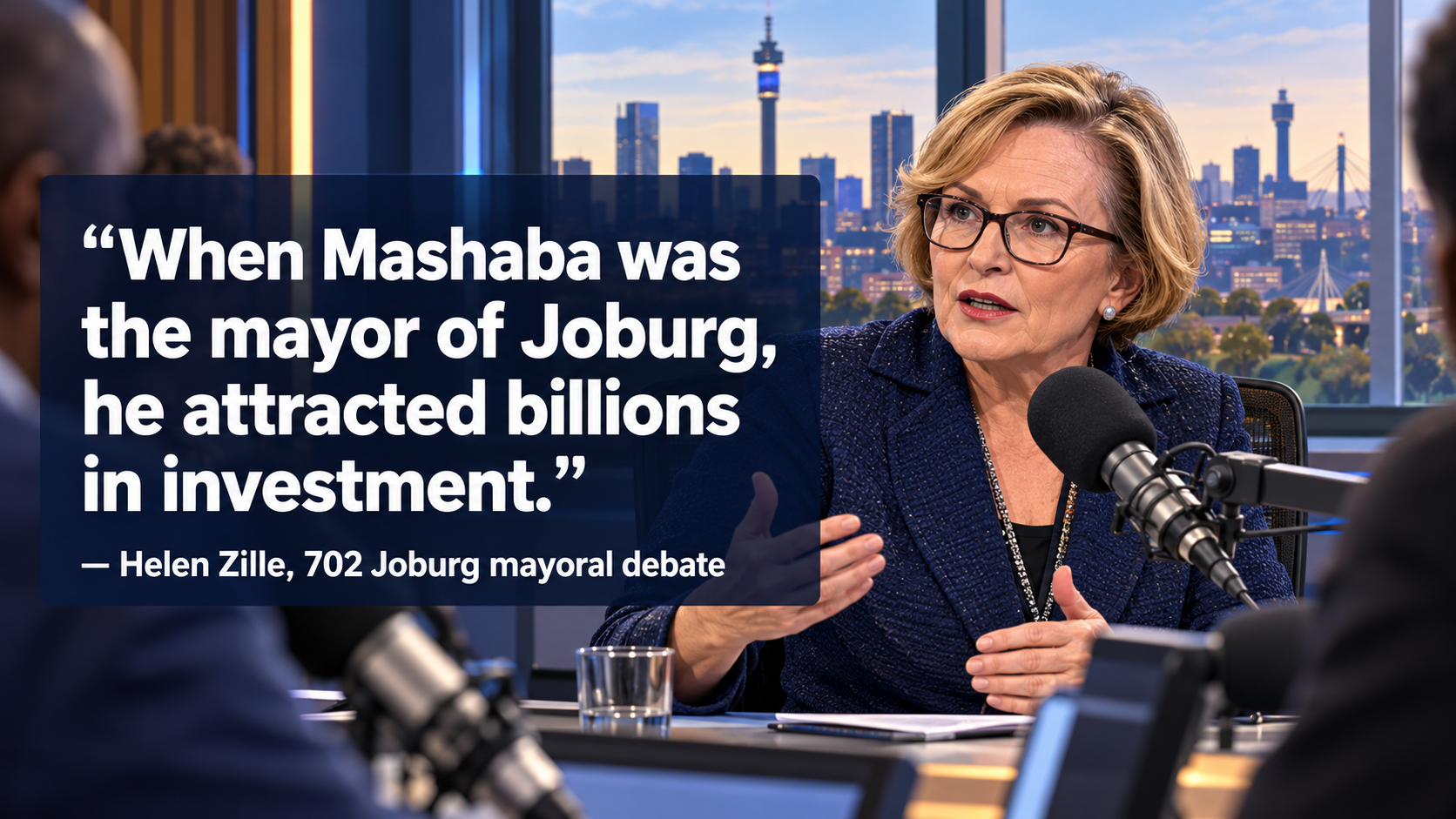
Johannesburg’s mayoral hopefuls used a live 702 debate to make their case for leading South Africa’s largest city — but the discussion also showed how difficult the next administration’s job will be.
Hosted by Clement Manyathela on 10 September, the debate brought together Jacob Mamabolo of the ANC, Helen Zille of the DA, Bongani Baloyi of the MK Party, Dr Tlaleng Mofokeng of the EFF, Ayanda Allie of ActionSA, Lukhona Mnguni of Rise Mzansi, Kenny Kunene of the Patriotic Alliance and Nobuntu Hlazo-Webster of BOSA.
The candidates differed sharply over who should take responsibility for Johannesburg’s decline and how the city should respond. Yet on one point there was little disagreement: water, electricity, roads, law enforcement and municipal administration will dominate the campaign ahead of the 4 November local government elections.
Service delivery became the real test
The debate repeatedly returned to the basic services residents experience every day. Candidates were pressed on water interruptions, electricity reliability, potholes, sewerage failures and the capacity of the city administration.
Zille presented the DA’s offer as a five-year programme focused on restoring core services and professional administration. The EFF argued for bringing basic services more directly under municipal control, stronger technical oversight of infrastructure spending and a larger share of municipal employment for young people. Other candidates placed varying emphasis on competent management, private investment, insourcing and more accountable political leadership.
Those promises will have to confront the city’s finances. Johannesburg’s approved 2026/27 budget totals R97.1 billion. The city has allocated R21.6 billion in operating expenditure to Johannesburg Water and R28.3 billion to City Power, but it also says the combined infrastructure-renewal backlog across Johannesburg Water, City Power and the Johannesburg Roads Agency exceeds R185 billion.
The scale of that gap matters. It means the election cannot only be a competition to announce new projects. The next administration will also have to decide which existing networks to repair first, how to improve revenue collection and how to prevent maintenance budgets from being consumed by repeated emergency work.
Mashaba’s record triggered the sharpest clash
The most heated exchange involved ActionSA and the DA over Herman Mashaba’s record as Johannesburg mayor between 2016 and 2019.
Allie argued that Mashaba deserved credit for changes achieved during his administration. The DA pushed back, saying those outcomes were produced by a wider coalition and by DA office-bearers rather than by one individual. The argument quickly became a larger dispute about political ownership, coalition partners and the relationship between Mashaba and the EFF during that period.
The exchange was more than campaign theatre. It exposed a question voters are likely to hear repeatedly: when a coalition government succeeds or fails, which party should receive the credit or blame?
Coalitions are not a side issue
Johannesburg’s fragmented council makes coalition government a central part of the election, not a scenario to discuss after the votes are counted. Candidates were challenged on whether they could govern without an outright majority and whether they would be able to maintain a stable administration.
This is where the debate was less conclusive. Parties spoke about accountability and stable leadership, but voters still need clearer answers about possible coalition partners, non-negotiable policy positions and the conditions under which a party would leave an agreement.
Without that information, a mayoral promise can be difficult to assess. A candidate may have an ambitious plan but still need several parties to approve budgets, senior appointments and major service-delivery decisions.
Immigration produced clear differences
Immigration and bylaw enforcement also divided the participants. The ANC emphasised stronger enforcement by national government. The EFF stressed the legal limits of municipal authority and the importance of documentation. The MK Party proposed a more direct Johannesburg enforcement capability working with other authorities.
The distinction is important because immigration control is primarily a national responsibility. A municipal administration can enforce bylaws, inspect buildings and work with national agencies, but it cannot replace Home Affairs or the national police. Voters should therefore examine whether proposals fall within the legal powers and budgets of the city.
What voters should ask next
The 702 debate introduced the field and revealed the main dividing lines, but the next phase should demand greater detail. Johannesburg residents need measurable commitments rather than broad promises.
- Which water, electricity and road projects will be prioritised in the first year?
- How will each party improve billing accuracy and revenue collection without placing an unfair burden on paying residents?
- What professional qualifications will be required for senior municipal appointments?
- Which services should remain in municipal entities, which should be insourced and where should private contractors be used?
- Which parties could form part of a governing coalition, and what written rules would hold that coalition together?
The debate showed that every major contender understands the public frustration surrounding Johannesburg. The harder test is whether their plans are financially realistic, legally possible and durable enough to survive coalition politics.
For voters, the most useful question may not be who delivered the strongest line in the studio. It is who can turn a campaign promise into a funded programme, secure council support and keep the city functioning for a full term.
Sources: 702’s Johannesburg mayoral debate; Eyewitness News debate report; Electoral Commission election-date announcement; and the City of Johannesburg 2026/27 budget summary.

Leave a Reply