Published by SA Business Team
There is something deeply wrong with paying a municipal bill and then paying somebody else to provide the same service.
Yet that has become normal for many South Africans.
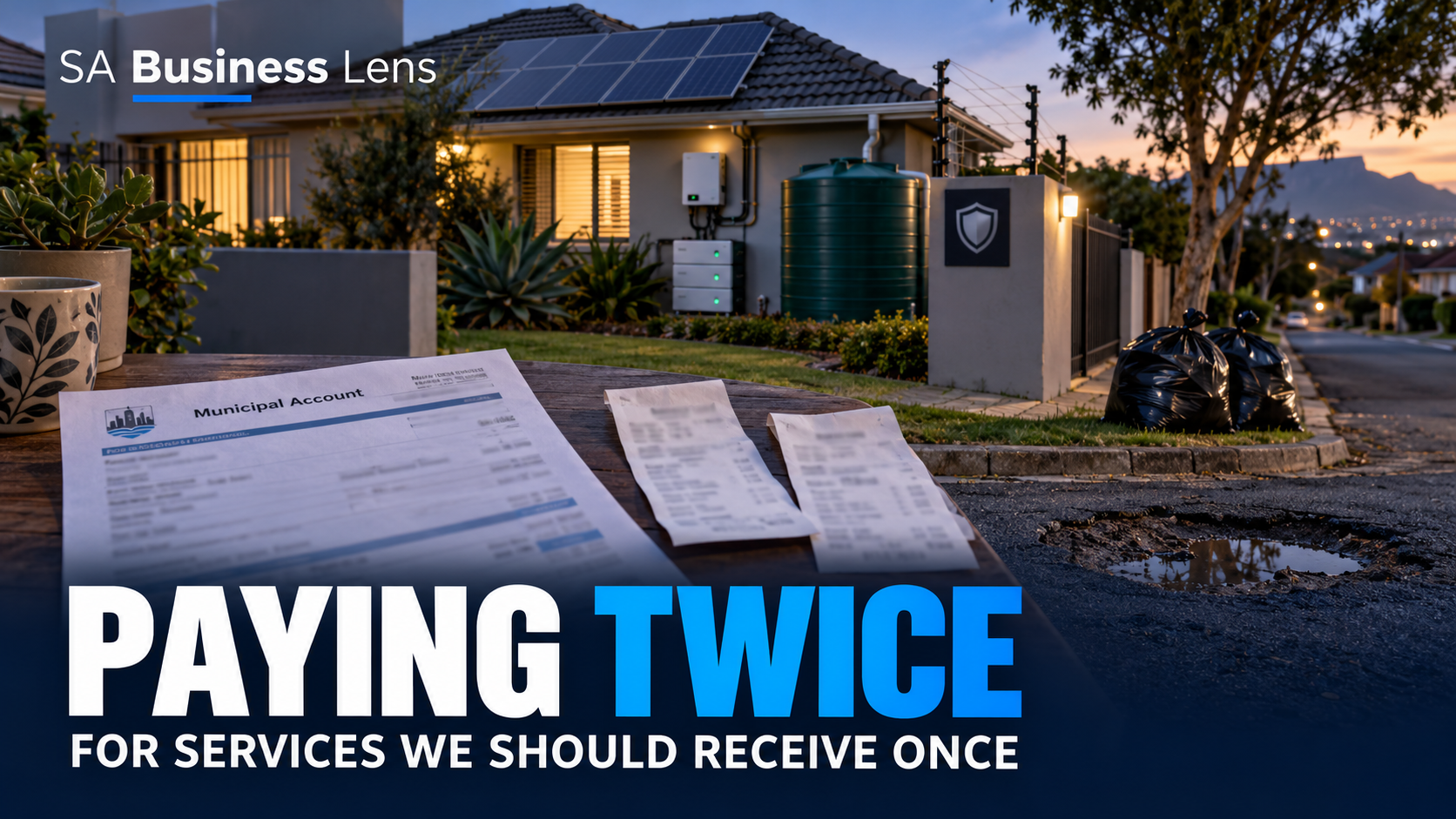
We pay for electricity, then buy an inverter or solar panels. We pay rates and taxes, then hire private security. We pay for water, but keep tanks and bottled water ready for the next interruption. Some communities even collect money to fix potholes, clean public spaces or remove rubbish themselves.
These are no longer luxury purchases. For many households and businesses, they are contingency plans for services that cannot always be trusted.
To be fair, South Africa has made real progress. Statistics South Africa reports that most households now have access to mains electricity, piped water and improved sanitation. Millions more people have these services than they did two decades ago.
But having a connection does not mean the service works when you need it.
A tap counts as access to water even when nothing comes out of it. A household remains connected to the electricity grid even when the power is off. Residents can be charged for refuse removal while bags pile up on the pavement.
That gap between access and reliability is where the second bill begins.
Families who can afford it protect themselves. They install backup power, increase their water storage and sign contracts with security companies. Businesses buy generators and make alternative arrangements so they can continue operating during disruptions.
Families who cannot afford these options simply carry the risk.
A power interruption can mean losing the food in the fridge. A water outage can mean missing work to find water elsewhere. An unreliable train or bus can cost someone a day’s wages. A slow police response can leave a family completely exposed.
The failure is the same, but the consequences are not.
This is why poor service delivery makes inequality worse. Wealthier households can buy their way around a failing system. Everyone else must wait for it to work.
Even those who can afford private alternatives lose something. Money spent on generators, batteries, water tanks and security could have paid school fees, reduced debt or helped grow a small business.
Companies face the same problem. Every rand spent working around unreliable public infrastructure is a rand that cannot be invested in new equipment, better salaries or another employee. Those costs eventually reach the public through higher prices.
What is most concerning is how ordinary all of this has become.
We rarely stop to ask why a home needs its own miniature power station, water reserve and security service. We compare inverter prices, monitor outage groups and keep emergency numbers saved on our phones. We have become remarkably good at adapting.
But adapting is not the same as solving the problem.
Government departments and municipalities often ask residents to be patient. Infrastructure is old. Budgets are limited. Repairs take time. All of that may be true.
It is also true that patience costs money.
It does not replace groceries spoiled during an outage. It does not refund the shop owner who could not trade. It does not cover the monthly armed-response fee or the cost of another emergency water delivery.
Residents deserve honest communication and clear standards. If a fault is reported, they should be able to see who is responsible for it and when it is expected to be fixed. Municipalities should publish performance information that ordinary people can understand, not reports designed to hide failure behind percentages and technical language.
There should also be consequences when residents repeatedly pay for services they do not receive. A private company could not ignore its customers indefinitely while continuing to charge the full amount. Municipalities should not be allowed to treat residents that way either.
South Africans are not asking for a country where nothing ever breaks. They are asking for services that work most of the time and officials who take responsibility when they do not.
That is not an unreasonable demand.
Taxes and municipal charges are meant to fund systems that serve everyone. The whole point of public infrastructure is that we should not each have to provide electricity, water, safety and clean streets for ourselves.
When those public systems fail, the expense does not disappear. It is simply pushed onto households and businesses.
And that leaves South Africans paying twice for services they should only have to pay for once.
This article represents an editorial opinion of SA Business Lens.
Sources: Statistics South Africa: General Household Survey 2025, Statistics South Africa: service-delivery trends and the World Bank’s assessment of South Africa’s infrastructure constraints.

Leave a Reply