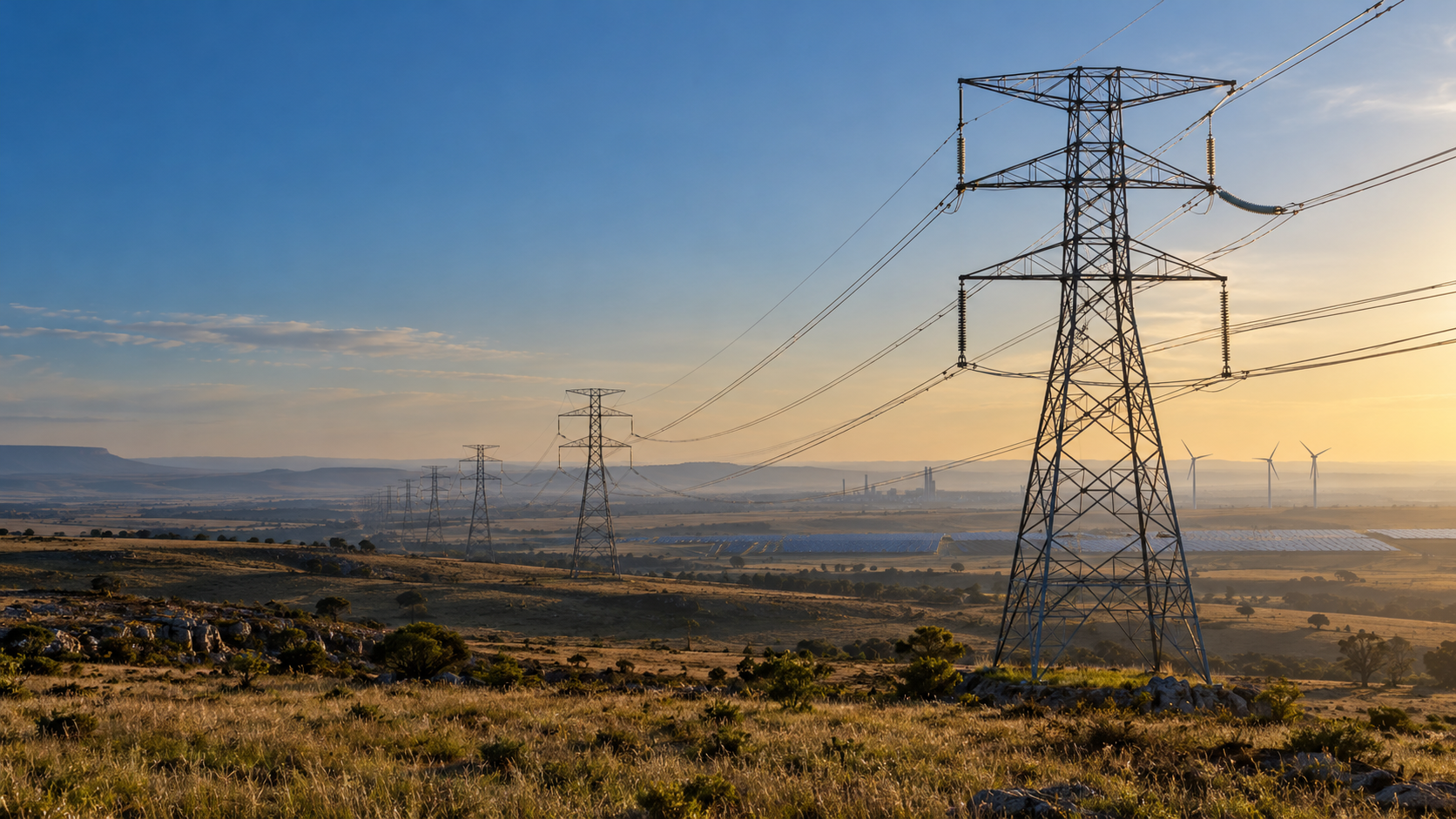
South Africa’s electricity challenge is changing. The country is bringing more generation online, but the network needed to move that power is entering a far more demanding phase.
The numbers tell the story. South Africa plans to add exactly 14,494 kilometres of transmission lines between 2025 and 2034 — rounded to 14,500 kilometres in this article’s headline. That is roughly the distance from Johannesburg to Cape Town and back more than ten times.
But the work is not spread evenly across the decade. Most of it sits on the far side of 2027.
The steep climb begins in 2028
The National Transmission Company of South Africa’s schedule starts modestly: 286 kilometres in 2025, 423 kilometres in 2026 and 550 kilometres in 2027. The target then leaps to 1,662 kilometres in 2028.
From there, the annual programme stays close to or above 1,900 kilometres for much of the period that follows.
SA Business Lens calculated that only about 9% of the ten-year total is scheduled for the first three years. Put differently, more than 90% must be delivered from 2028 onwards.
The full plan works out to an average of about 1,449 kilometres a year. That is more than three times the 423-kilometre target for the 2026 financial year.
This is not evidence that the programme has already fallen behind. It is meant to accelerate as procurement systems, contractors and equipment supply come into place. It does, however, show just how large that acceleration must be.
New generation needs somewhere to go
Transmission lines are the long-distance routes of the electricity system. They carry bulk power from generating areas to major demand centres, before lower-voltage networks take over.
That matters because some of South Africa’s best wind and solar resources are far from its biggest electricity users. A project can have land, finance and environmental approval and still face a long wait if there is no practical grid connection nearby.
An Eskom and NTCSA system briefing says the current expansion plan could unlock 56GW of new generation capacity over ten years. One gigawatt is equal to 1,000 megawatts, although the electricity actually produced depends on the technology and its operating conditions.
The official project map stretches across the country. It includes Northern Cape strengthening, an Eastern Cape-to-KwaZulu-Natal corridor, work in the Central Cape and along the West Coast, as well as projects around Johannesburg, the Lowveld and KwaZulu-Natal.
A 34GW connection pipeline
The pressure is already visible in the queue.
An Eskom system briefing recorded 34GW of private-sector projects for wheeling or own use at various stages of the connection process. Only 4GW of that total was in execution and expected to connect by the 2028 financial year.
The balance included projects with cost-estimate letters, budget quotations in progress or quotations already issued. Those are development steps, not completed power stations, so the 34GW should not be mistaken for electricity that is already available.
Even so, it gives a sense of what is waiting on the other side of the grid build. Delays affect more than electricity developers. They can hold back construction orders, local manufacturing, industrial expansion and new supply agreements for businesses.
Private capital enters the transmission network
Government is trying a new approach. Its Independent Transmission Projects Programme will introduce private participation in national transmission infrastructure for the first time.
The first phase covers about 1,164 kilometres. Seven bidders have made it through pre-qualification, but binding bids have not yet been invited. Government is still working through the commercial structure, risk allocation and payment security.
An earlier programme notice anticipated a final request for proposals in the third quarter of 2026. The latest government update, published in October 2026, moved that milestone to the second quarter of 2027 while further consultation and governance work is completed. The 1,164 kilometres should therefore be understood as a procurement pipeline, not infrastructure that has already been built.
The same October 2026 government update says a Credit Guarantee Vehicle is being developed alongside the programme. Its purpose is to strengthen payment security and give lenders greater clarity about risk. Because bidders need that information before pricing binding offers, the guarantee work is one reason the procurement timetable and consultation process are moving together.
The opportunity reaches well beyond energy companies
A transmission build of this size would create demand across a long supply chain: steel towers, transformers, cables, substations, civil works, engineering, transport, environmental services and specialist maintenance.
Government says local-content and industrial-development requirements will form part of the private transmission programme. That will not automatically place every contract with a South African supplier, but it gives manufacturers and contractors a visible pipeline against which to plan investment, hiring and training.
NTCSA previously allocated R133 billion to the first five years of its broader Transmission Development Plan. That figure is not the price of the private Phase I programme; the two cover different scopes.
Early progress is only the opening act
NTCSA built 292.6 kilometres of transmission lines in the 2025 financial year, slightly ahead of its 286-kilometre target.
At the time of Eskom’s September 2025 system briefing, 108.2 kilometres had been completed against a 423.1-kilometre target for the 2026 financial year. That was an update during the year, not a final result.
The early construction matters, but it is not yet the pace the later programme demands. From 2028, multiple large projects will have to move at once. Land and servitudes must be secured. Environmental approvals must be completed. Towers, transformers and cables must arrive on time. Engineers, construction teams and finance must all be available together.
For years, South Africa’s electricity debate was dominated by whether the country could generate enough power. The next question is more physical: can it build the network quickly enough to move that power where it is needed?
Sources and methodology
SA Business Lens reviewed the NTCSA Transmission Development Plan, Eskom’s system briefing, the Department of Electricity and Energy and National Treasury’s October 2026 update, and documents published by the IPP Office.
The percentages and annual averages are SA Business Lens calculations based on the official annual construction schedule. Figures from different publications may use different reporting dates or programme boundaries, so they have not been combined.



Leave a Reply