By SA Business Lens
23 October 2026
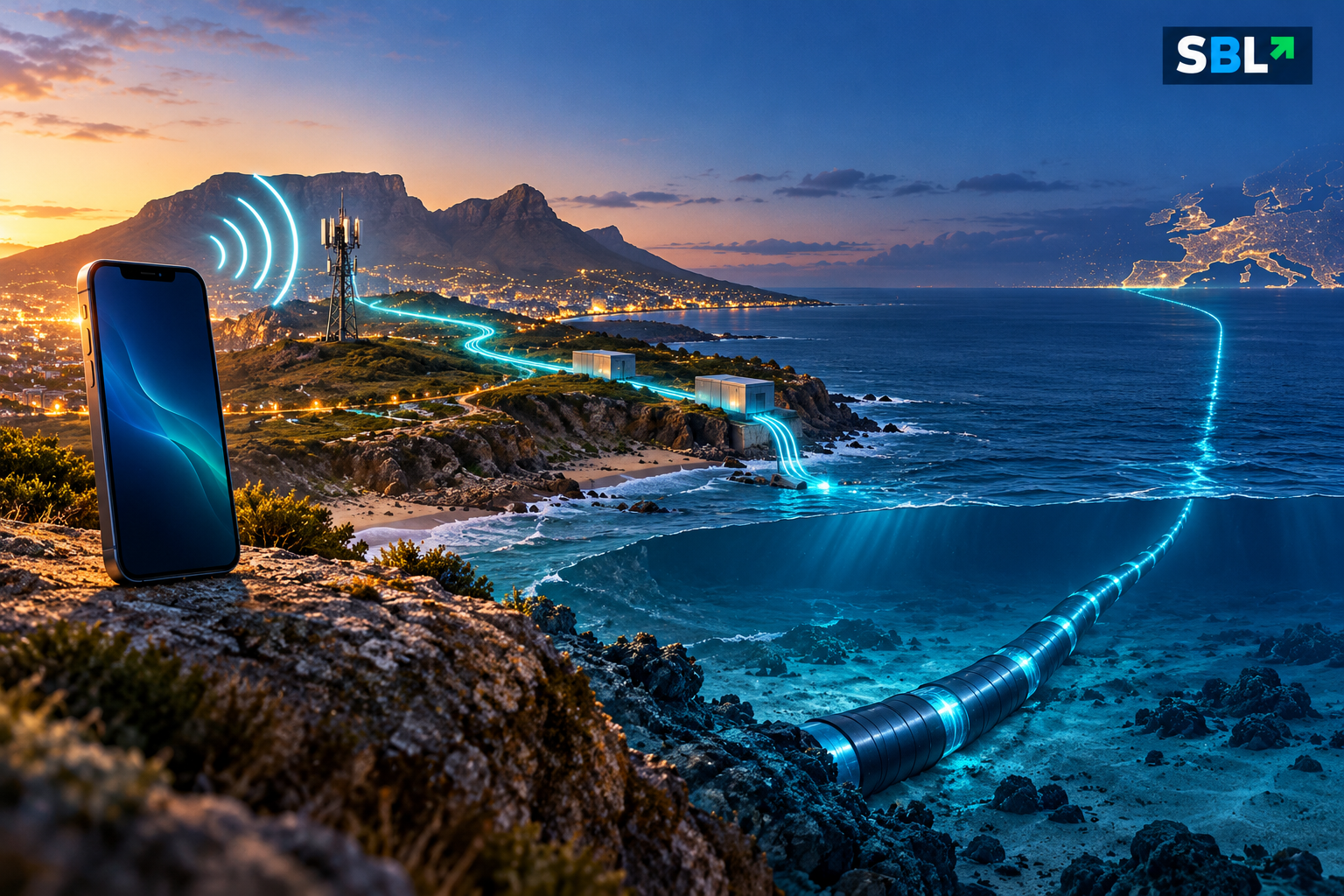
A tap on your phone can begin with Wi-Fi or a mobile signal and continue through fibre on land and beneath the Atlantic. For South Africans, that physical journey helps explain why the network behind an ordinary internet connection stretches far beyond the nearest tower.
The International Cable Protection Committee says submarine cables carry the vast majority of international data traffic. Its media FAQ, updated on 20 May 2026, also explains how networks use alternative land and sea routes when faults occur. ICPC
From your screen to the coast
Your phone connects wirelessly to a Wi-Fi router or mobile base station. Beyond that, traffic moves through the provider’s network. Mobile backhaul, the connection from base stations into the wider network, can use fibre or wireless links. GSMA backhaul report, September 2018
For an overseas destination reached by subsea cable, land-based fibre connects inland networks to the coast. SEACOM’s October 2019 account of its N1 fibre route describes connections between major South African cities, data centres and cable landing stations. SEACOM
Here is a simplified journey, rather than a trace of any particular connection:
| Stage | What it does |
|---|---|
| Phone to router or tower | Connects your device to a network |
| Land-based network | Carries traffic between towns, cities and network facilities |
| Cable landing station | Connects the land network to the submarine system |
| Undersea fibre | Carries data across the ocean |
A South African example
Equiano provides a concrete example. WIOCC’s network page lists a route from Portugal along Africa’s west coast, with a South African landing at Melkbosstrand. WIOCC says the system adds route diversity to its other west-coast cables. This is one available route, not evidence that your particular call or download uses Equiano. WIOCC
Some traffic can stay local
Opening an international service does not necessarily mean every piece of content must be fetched from overseas. A content delivery network can store copies closer to users, a process called caching.
Google Cloud’s cache-location list, updated on 20 October 2026, includes Johannesburg. Its documentation explains that content such as images and video can be cached, while not every response is suitable. A locally available copy may therefore be delivered without fetching that content across an ocean for each request. The actual path depends on the service and network. Google cache locations, caching overview
More routes do not remove every risk
ICPC describes geographically diverse submarine and terrestrial routes as a way to reroute traffic around faults. SEACOM likewise describes a backbone combining subsea systems and redundant land routes. ICPC, SEACOM network
The practical takeaway is to ask a provider what its backup route covers. An alternative international path does not, by itself, establish that every part of your connection is protected or that every service will be unaffected.
SBL bottom line
South Africa’s internet depends on connections between local access networks, inland fibre, coastal landing stations and overseas cables. For a business that relies on connectivity, ask about those routes and the backup arrangements, rather than judging resilience only by the advertised line speed.
Sources and limits
Primary industry and operator sources were checked on 23 October 2026. The GSMA technical report and SEACOM’s N1 example date from 2018 and 2019; undated network pages describe their operators’ networks. This explainer does not measure a reader’s route or speed, diagnose a current outage, or predict retail prices.
Featured image: SBL editorial illustration of a phone connection moving through a wireless hop, land fibre and an undersea cable. It does not depict a real cable route or landing station.


Leave a Reply