
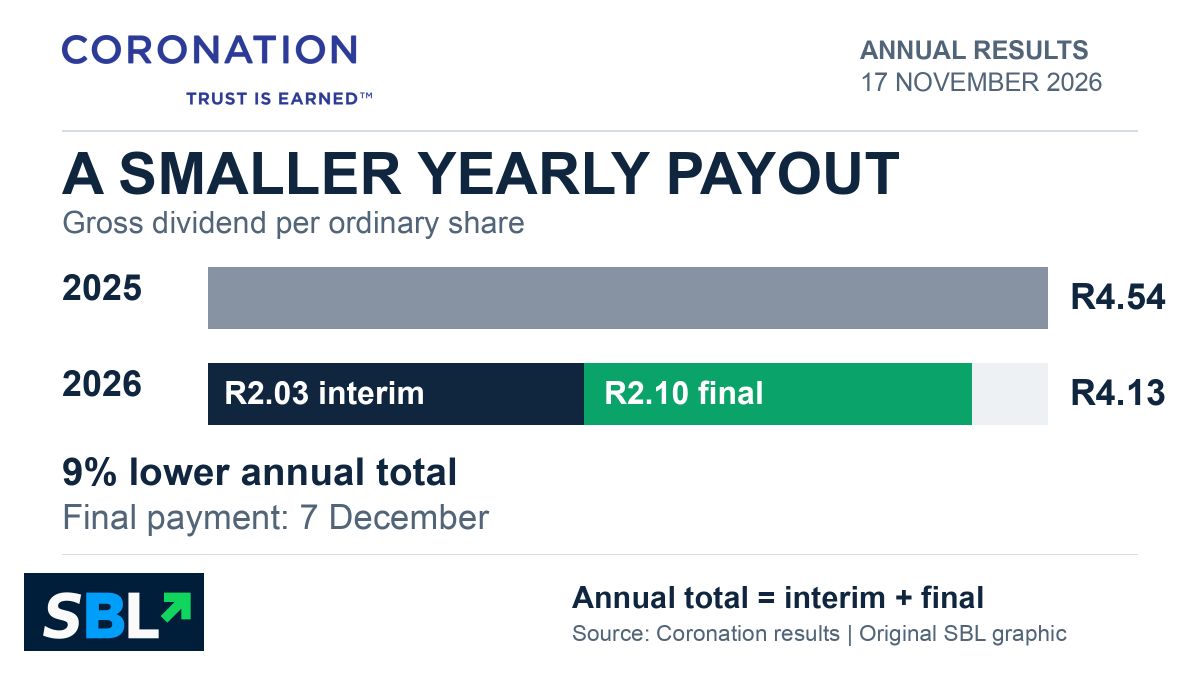
Original SBL graphic showing Coronation’s gross dividends per ordinary share. The annual total includes the interim and final payments.
Coronation Fund Managers has reduced its dividend for the year ended September 2026 to R4.13 a share, from R4.54 a year earlier. The 9% decline comes with an important distinction for shareholders: the next payment is R2.10, rather than another R4.13.
The annual figure adds together the R2.03 interim dividend and the newly declared R2.10 final dividend. Coronation’s 17 November results presentation shows both components alongside the previous year’s payments.
What changes in the next payment
The final dividend is down from R2.54 a share a year earlier. SBL calculates that as a decline of about 17%, which is larger than the 9% fall in the combined annual payout.
For someone planning around dividend income, those percentages answer different questions. The annual comparison measures the whole financial year’s distributions; the final comparison measures this particular payment against its equivalent last year.
| Gross dividend per share | 2025 | 2026 |
|---|---|---|
| Interim | R2.00 | R2.03 |
| Final | R2.54 | R2.10 |
| Annual total | R4.54 | R4.13 |
The December dates to check
The company’s dividend declaration gives 1 December as the last day to trade with entitlement to the final dividend. Shares start trading without that entitlement on 2 December. The record date is 4 December and payment is scheduled for 7 December.
Coronation declares R2.10 gross per ordinary share, or R1.68 after 20% dividends tax for shareholders to whom that withholding applies.
As a simple SBL calculation, 1,000 eligible ordinary shares would produce R2,100 gross, or R1,680 if the full 20% is withheld. That illustration assumes an eligible holding and does not establish anyone’s individual tax treatment.
Why the annual payout is smaller
The reviewed financial statements show revenue broadly unchanged at R4.292 billion, operating costs up 4% and profit down 8% to R1.540 billion. KPMG issued an unmodified review conclusion. A review has a substantially narrower scope than an audit.
These are results for the listed asset-management business. They do not mean that people invested in its unit trusts earned the same return as its shareholders or lost 9% of their fund value.
Three checks before counting the income
- Check the investment: confirm whether you hold Coronation ordinary shares or units in one of its funds. They are different investments.
- Count each payment once: reconcile the interim payment with the final declaration. Adding the annual total again would overstate the income.
- Check your broker’s record: confirm the eligible shareholding, withholding treatment and payment details against your account. Do not assume the gross figure is the amount that will arrive.
The declaration does not promise a future dividend. Nor should the payment date alone determine an investment decision.
Sources
- Coronation reviewed annual financial statements and dividend declaration, 17 November 2026
- Coronation annual results presentation, 17 November 2026, dividend comparison on page 22
- Company stock-exchange announcement, 17 November 2026, 07:05



Leave a Reply