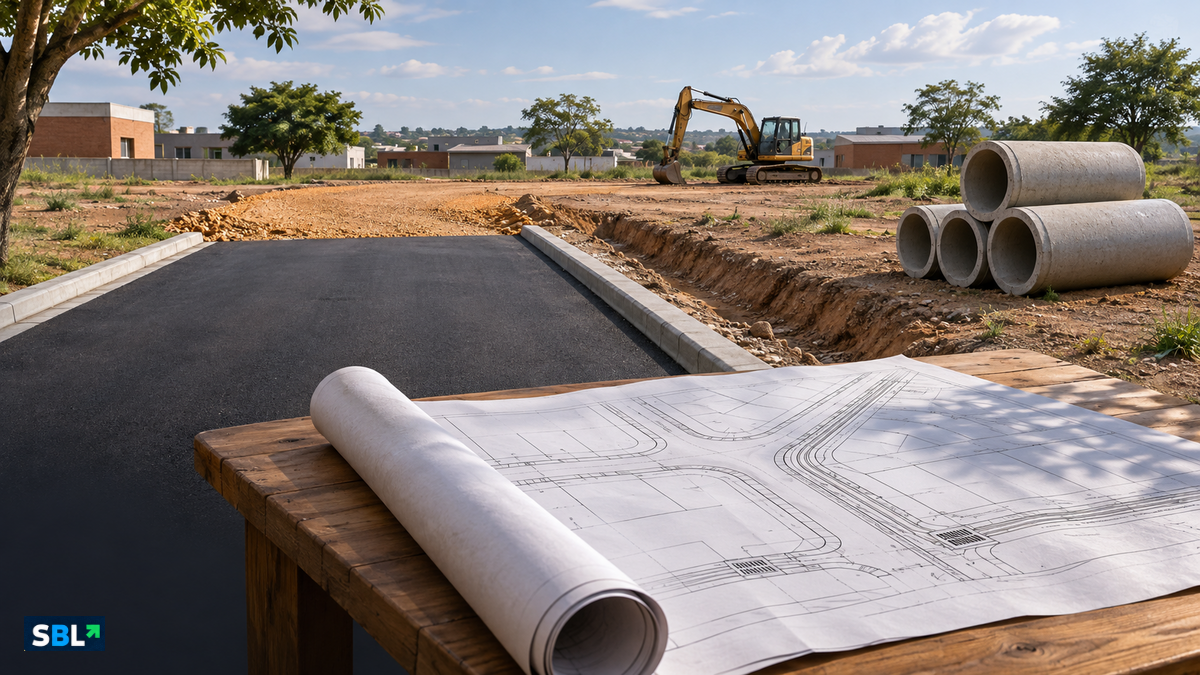
A municipal budget can promise substantial investment without showing whether projects are ready, funding has arrived or completed work is delivering a service. South Africa’s latest full-year spending figures make those distinctions important.
With local government elections taking place on 4 November, voters and businesses have reason to look beyond the size of the next infrastructure announcement.
National Treasury’s preliminary report, published on 16 September 2026, records R65.3 billion in municipal capital expenditure against an adjusted budget of R83.9 billion for 1 July 2025 to 30 June 2026. The gap was approximately R18.6 billion. These are full-year figures, despite appearing in a report labelled “fourth quarter”.
The comparison that matters
SBL calculated the proportion of each adjusted budget that municipalities reported spending:
| Measure | Capital | Operating |
|---|---|---|
| Adjusted budget | R83.9bn | R630.7bn |
| Recorded expenditure | R65.3bn | R587.3bn |
| Budget spent | 77.8% | 93.1% |
Capital spending therefore lagged operating-budget execution by 15.3 percentage points. Put simply, municipalities recorded roughly R78 of capital expenditure for every R100 budgeted, compared with R93 for operations.
A second calculation shows that 37.2% of the year’s capital spending was recorded in April–June, the final quarter. That concentration makes project-level timing important, although expenditure records alone cannot show when construction physically happened.
Source: Treasury’s underlying tables, page 1.
Why the gap is not necessarily spare cash
A budget is a spending plan. Subtracting recorded expenditure from that plan does not establish the balance in a bank account.
National Treasury’s explanation of the Municipal Finance Management Act funding framework says a funded municipal budget draws on realistically anticipated collections or cash-backed surpluses. Expected income and cash already available are different things.
Treasury warns that unrealistic municipal revenue forecasts can create cash-flow problems. It also identifies weak project planning, late implementation plans and procurement difficulties as obstacles to spending.
The national gap could therefore reflect different problems in different places. The published total does not allocate every rand between delayed projects, financing shortfalls or other causes.
Source: Treasury’s explanation, pages 1, 4 and 5.
Spending more is only part of the test
The Auditor-General’s report released on 24 June 2026, covering the earlier 2024/25 financial year, supplies a separate warning about delivery.
Auditors examined 129 infrastructure projects with an estimated combined cost of R14.16 billion. They reported findings on 101 projects, or 78%, and an average project delay of 25 months.
That is an audited selection, not a failure rate for every municipal project. It nevertheless shows why an expenditure percentage needs to be accompanied by evidence that assets were completed and work as intended. These audit findings cannot explain the entire subsequent year’s capital-spending gap.
Source: Auditor-General’s findings.
Four questions behind the next project announcement
For a water scheme, road upgrade or other capital project, a more useful assessment starts with four questions:
- What is funded? Identify the project’s approved amount and funding source.
- What is ready? Check whether design, procurement and necessary approvals are complete.
- What has happened? Compare expenditure with physical milestones, rather than treating payment as completion.
- What remains? Ask for the outstanding work, revised completion date and reason for any delay.
A larger budget may signal greater ambition. The stronger evidence is a funded project that moves through measurable milestones and ultimately provides a working service.
Data note: Treasury’s figures are preliminary municipal submissions covering 257 municipalities. National totals conceal substantial local differences and are not a ranking of councils or proof of missing money.
Leave a Reply