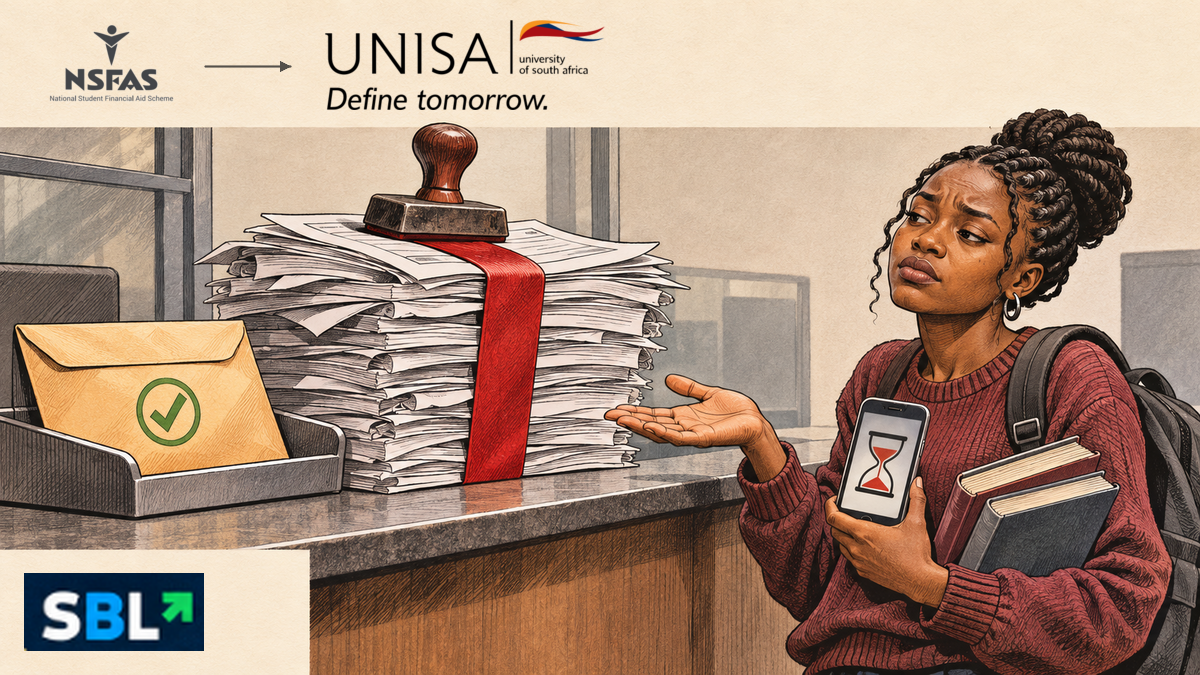
Editorial illustration: SA Business Lens.
NSFAS says it transferred Personal Care Allowance funding to Unisa on 30 October. A government statement published on 9 November explains why some November payments still required further processing at the time of a 6 November meeting.
For a student planning essential spending, the useful question is where their individual payment stands, rather than whether money has moved between institutions.
What the latest statement establishes
According to the Department of Higher Education and Training statement, Unisa was reportedly reconciling payments and awaiting internal approvals. NSFAS undertook to engage the university on 9 November and provide an update.
That was a commitment to follow up, not a confirmed date for every student to receive money. SBL had not located a newer official notice confirming resolution when checking on 10 November.
Why a transfer is only one step
Unisa’s student-funding FAQs, last modified on 28 August, say the institution pays NSFAS allowances into students’ bank accounts by EFT. They also say banking-detail update links are sent to students’ myLife email accounts.
The distinction matters: a transfer to Unisa, the university’s release of an individual payment and that payment appearing in a bank account are different stages. An institutional transfer date should therefore not be treated as proof that a particular student has been paid.
What affected students can check
In its 16 July allowance-payment guidance, Unisa advises students with missing or lower-than-expected payments to:
- Check their NSFAS funding status.
- Ensure their banking details are current and correct.
- Confirm that the university has the information needed to finalise payment.
Unisa lists [email protected] for affected students. This is standing guidance, not a new November payment announcement.
The 9 November statement also directs unresolved NSFAS issues to Deputy Minister Yusuf Cassim’s helpdesk at [email protected]. The office escalates and follows up on queries; it does not control NSFAS payments.
SBL’s view: students need a usable answer
An effective update should tell a student whether their payment is awaiting reconciliation, approval, missing information or bank processing, and what they need to do next. Simply repeating that funds were transferred does not answer those questions.
For households relying on an allowance, uncertainty can make it harder to plan essentials or avoid short-term borrowing. That is why clear payment-stage information matters alongside the payment itself.
The next useful development would be a dated Unisa or NSFAS update identifying what has been cleared, what remains outstanding and the expected payment timing. Until then, students should seek information about their own case rather than budget around an unverified payout date.
Last checked: 10 November 2026. Sources: DHET statement, 9 November 2026, reporting on the 6 November meeting; Unisa allowance guidance, 16 July 2026; Unisa student-funding FAQs, last modified 28 August 2026.


Leave a Reply