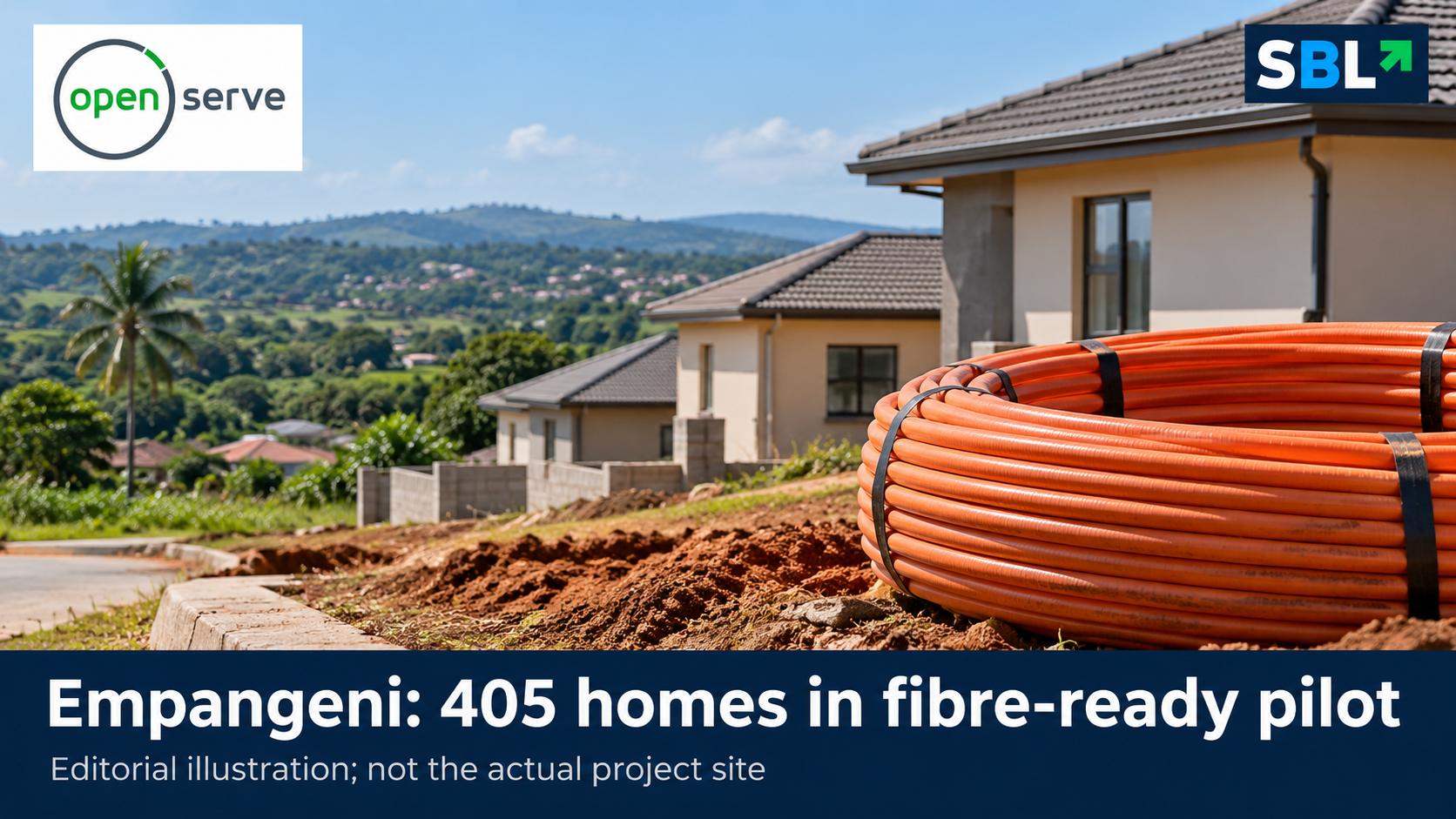
The Empangeni pilot prepares 405 homes for future fibre connectivity. Editorial illustration; not the actual project site.
A fibre-readiness pilot at Empangeni’s Phase 1A housing development will put infrastructure for future internet connections into 405 homes while they are being built. Residents still need a service rollout and activation before they can use it.
By SA Business Lens Team
25 October 2026
SAnews reports that KwaZulu-Natal Premier Thamsanqa Ntuli launched the Fibre Pre-Provisioning Proof of Concept on Thursday, 22 October 2026. Its report identifies Empangeni Phase 1A as the implementation site and Huawei and Openserve as partners.
The 405 homes are under construction. They are the pilot’s scope, not a count of households already online or a fibre commitment covering the entire Empangeni housing development.
What fibre-ready means for residents
The project uses a “Pipe and Box” method, incorporating infrastructure for connectivity while the housing and other services are being built. A Huawei-authored launch account carried by TechNation explicitly says the proof of concept does not itself provide fibre services.
The practical distinction is between preparing a route for a future connection and having a working internet service. The published descriptions support calling these homes fibre-ready. They do not establish that fibre cable, connected equipment and an activated service have been completed at every house.
Openserve’s general installation guidance explains that a working connection involves an optical network terminal, or ONT. Depending on the product, that device may provide Wi-Fi itself, or an internet service provider activates the service and supplies a separate router. That guidance describes the usual connection process, not a confirmed package for this pilot.
The launch material reviewed gives no date when residents can order or activate services, no household tariff and no promise of free internet.
Lower construction costs need to reach the household
Putting infrastructure in place before roads are finished could avoid digging them up again. SAnews reports Huawei solution manager Li Yanbang’s argument that installing during or before road construction can reduce costs and prevent damage from later excavation.
That is a case for better construction planning. Whether it produces affordable internet for residents is a separate question.
A cheaper route to the front door could reduce one part of the cost of providing a connection. A household must still be able to afford the service offered over it. Without a published tariff, subsidy arrangement or measured saving, there is no basis for putting a rand value on what families will save.
For residents comparing future offers, the useful figure will be the total cost: any installation or activation charge, equipment costs and the ongoing subscription or prepaid payment. The lowest advertised monthly price alone may not answer that question.
What the pilot still needs to show
The next useful results would include the cost per home of preparing the infrastructure, the work still required to connect it, and how many households eventually take up a service.
Residents also need clarity on who maintains the pipes and boxes, who fixes faults, and which providers and packages they can choose. Those site-specific arrangements are not settled by the announcements reviewed.
SAnews reports that Openserve intends to assess the project and share findings with government. Publishing those results would help other housing developers judge the approach before adopting it more widely.
Empangeni’s pilot addresses an early obstacle: making space for connectivity during construction. Its value to families will become clearer when working services and affordable offers follow.


Leave a Reply