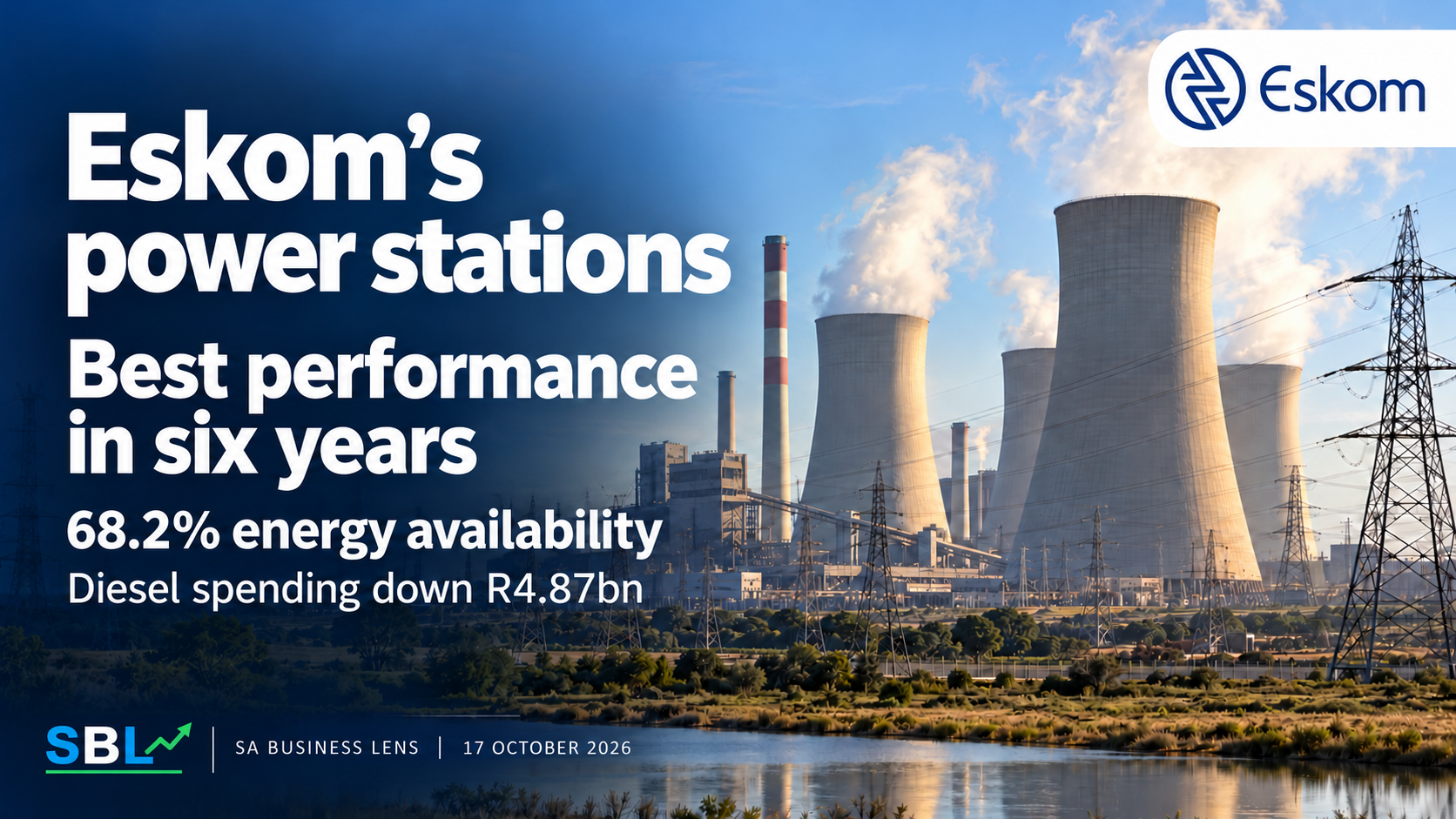
South Africa’s electricity recovery is showing further progress, with Eskom reporting a financial year-to-date Energy Availability Factor (EAF) of 68.2% — its highest comparable performance in six years.
The figure covers 1 April to 15 October 2026, compared with 62.63% during the corresponding period last year. That represents an improvement of 5.57 percentage points. Eskom published the update on Friday, 16 October.
What does 68.2% actually mean?
EAF measures how much of a power fleet’s capacity is available to generate electricity over a reporting period, after accounting for outages and other capacity losses.
It does not mean households receive electricity for only 68.2% of the day. Electricity supply also depends on demand, other generators and the condition of the networks delivering power.
The numbers behind the recovery
| Measure | Corresponding period in 2025 | Latest reported period in 2026 |
|---|---|---|
| Financial year-to-date EAF | 62.63% | 68.2% |
| Financial year-to-date diesel spending | R6.05 billion | R1.18 billion |
| Average weekly unplanned outages, 9–15 October | 10,646MW | 7,707MW |
Eskom’s figures show diesel expenditure falling by R4.87 billion, or 80.47%, alongside lower unplanned outages.
For businesses, sustained electricity reliability can make production schedules, trading hours and operating costs easier to manage. Lower reliance on emergency generation also provides a stronger foundation for planning investment.
However, the improvement does not automatically translate into lower electricity tariffs or uninterrupted supply at every property.
The latest update also included a setback: Koeberg Unit 1 tripped on 16 October. Eskom said the station remained safe and sufficient generation was available to meet demand.
The business test now is whether stronger generation performance can be sustained — and translate into dependable electricity where companies actually operate.
Has electricity reliability improved at your business, or are local outages still disrupting your operations?
Source: Eskom power system update, 16 October 2026.



[…] our report on Eskom’s latest operational update, this follow-up explains the difference between a stronger national power system and the experience […]