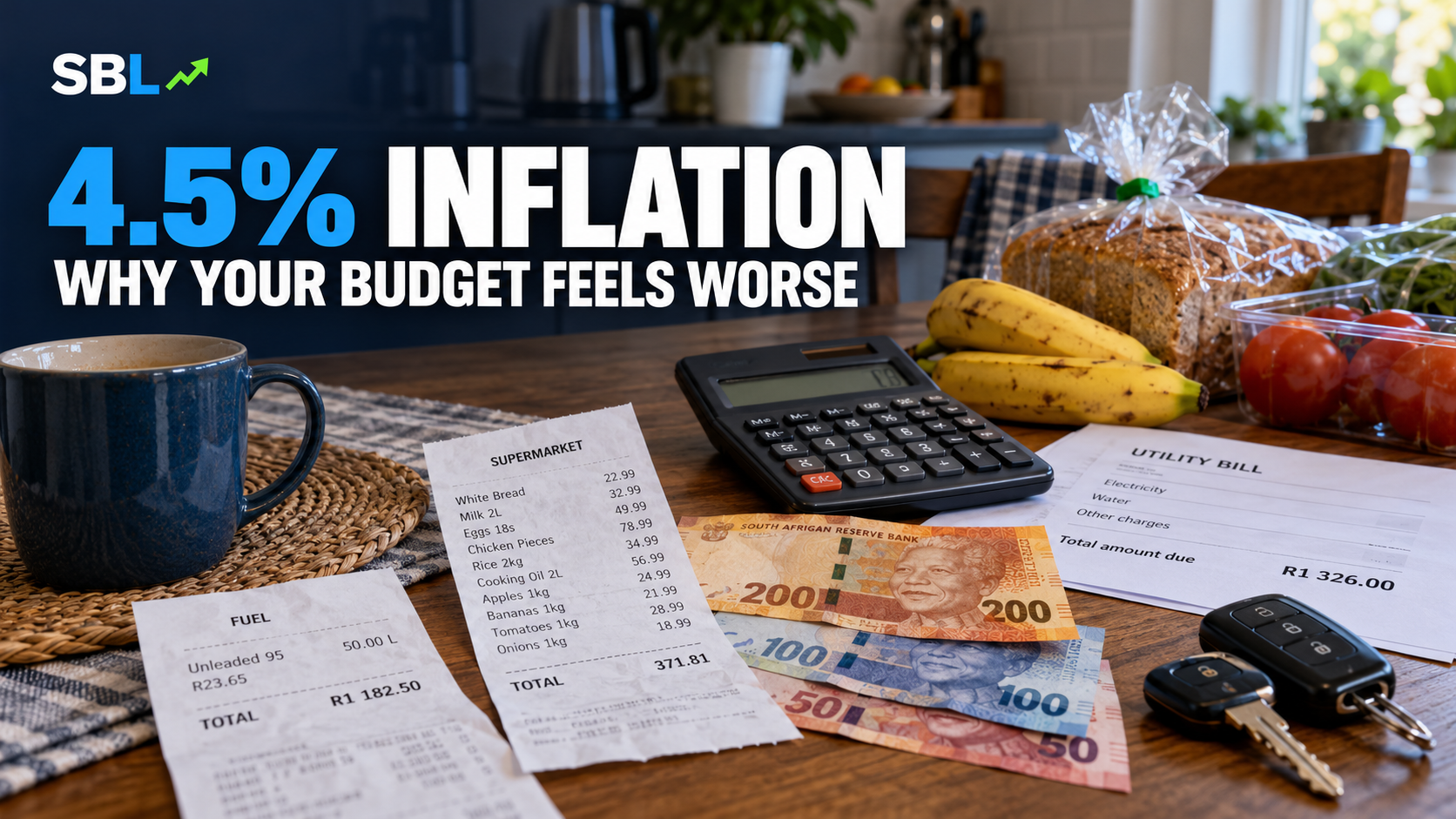
South Africa’s annual inflation rate increased to 4.5% in September, but that national average does not describe every household. Transport, housing and financial-service costs are rising faster than the headline number, leaving many families feeling a much sharper squeeze.
Statistics South Africa reported that consumer prices increased by 0.4% between August and September 2026. Annual inflation rose from 4.4% to 4.5%, marking a second consecutive monthly increase.
The figure is accurate for the national consumer basket. It is not a promise that every person’s expenses rose by exactly 4.5%. Your own inflation rate depends on what you buy, where you live, how you travel and whether you carry variable-rate debt.
The inflation picture at a glance
| Measure | September 2026 | What it tells us |
|---|---|---|
| Headline CPI | 4.5% annually | Average prices were 4.5% higher than a year earlier. |
| Monthly CPI | 0.4% | Prices rose during September after no monthly change in August. |
| Goods inflation | 4.1% | Up from 3.3% in August. |
| Services inflation | 4.9% | Down from 5.1%, but still above headline inflation. |
Source: Statistics South Africa, Consumer Price Index, September 2026.
Three unavoidable costs are driving pressure
Transport recorded annual inflation of 10.8% and contributed 1.5 percentage points to the headline rate. Housing and utilities increased by 5.2%, contributing 1.3 percentage points. Insurance and financial services rose by 5.4%, adding another 0.6 percentage point.
| Expense category | Annual increase | Contribution to CPI |
|---|---|---|
| Transport | 10.8% | 1.5 percentage points |
| Housing and utilities | 5.2% | 1.3 percentage points |
| Insurance and financial services | 5.4% | 0.6 percentage point |
Together, those three categories accounted for 3.4 percentage points of the 4.5% headline rate. They are also difficult for many households to avoid or reduce quickly.
Fuel costs reach far beyond the petrol station
The fuel price index jumped by 6.2% in September and stood 27.9% higher than a year earlier. Diesel was 46% more expensive annually, while petrol prices had increased by 25%.
These increases affect motorists directly, but the impact travels further. Businesses pay more to move goods, delivery operators face higher costs and commuters experience pressure through public-transport fares. Annual inflation reached 18.6% for airfares, 14.1% for long-distance buses and 13.8% for minibus taxis.
Why your personal inflation rate may be higher
The official CPI assigns a weighting to each category based on average household spending. No individual household matches that national average exactly.
| Household situation | Likely exposure | Reason |
|---|---|---|
| Long daily commute | Higher | Fuel and passenger transport are rising much faster than headline CPI. |
| Variable-rate mortgage or loan | Higher financial pressure | The policy rate is 7.25%, affecting linked borrowing costs. |
| High insurance and utility bills | Higher | Both categories are increasing faster than headline inflation. |
| Large share spent on basic food | Potentially lower in September | Food and non-alcoholic beverage inflation was 1.2%. |
Lower food inflation does not mean cheap groceries
Annual food and non-alcoholic beverage inflation was 1.2%. Meat inflation slowed to 0.7%, and several beef products were cheaper than a year earlier. Cereal prices declined by 1.9% annually, although that category still rose by 0.3% during September.
A slowing inflation rate generally means prices are increasing more slowly. It does not automatically reverse increases accumulated in previous years. Households only recover lost purchasing power when prices fall meaningfully or incomes grow faster than their expenses.
Interest rates add another layer
The South African Reserve Bank raised its policy rate by 25 basis points to 7.25% in September. It cited higher fuel prices, global supply disruptions and continued inflation risks.
Higher rates are intended to contain inflation and inflation expectations. They also raise repayments on variable-rate debt, adding pressure for homeowners, consumers and businesses that borrow at rates linked to the policy cycle.
The Reserve Bank expects inflation to move back towards its 3% target near the end of 2027. A single CPI release does not confirm the next interest-rate decision, which will depend on the wider economic outlook and incoming data.
Calculate your own household inflation
A practical personal estimate starts with recurring expenses rather than the national basket.
- List what you spent on major categories 12 months ago.
- Record the current cost of the same categories.
- Calculate the percentage change for each category.
- Give more weight to the categories that consume the largest share of your budget.
- Separate price increases from new purchases, extra debt or lifestyle changes.
What households should watch next
Fuel remains the clearest near-term risk because it influences transport, production and distribution costs. Municipal tariffs, electricity, insurance and other services also matter because these costs can remain persistent even when volatile food or fuel prices ease.
El Niño is an additional risk to agricultural output and future food prices. Its actual effect will depend on rainfall, crop conditions and the severity of the weather event, so it should be treated as a risk rather than a guaranteed price increase.
The bottom line
South Africa’s 4.5% inflation rate is a national average, not a description of every family’s finances. Households that spend heavily on transport, housing, insurance and debt may be experiencing considerably more pressure.
The useful question is not only whether inflation is 4.5%. It is which prices are increasing, how heavily those expenses feature in your budget and whether your income is keeping pace.
This article was independently developed by SA Business Lens to explain official economic data and its practical implications. It combines verified public statistics with original analysis and does not constitute personal financial advice.
Sources: Statistics South Africa, Consumer Price Index, September 2026; South African Reserve Bank, September 2026 Monetary Policy Committee statement.


Leave a Reply