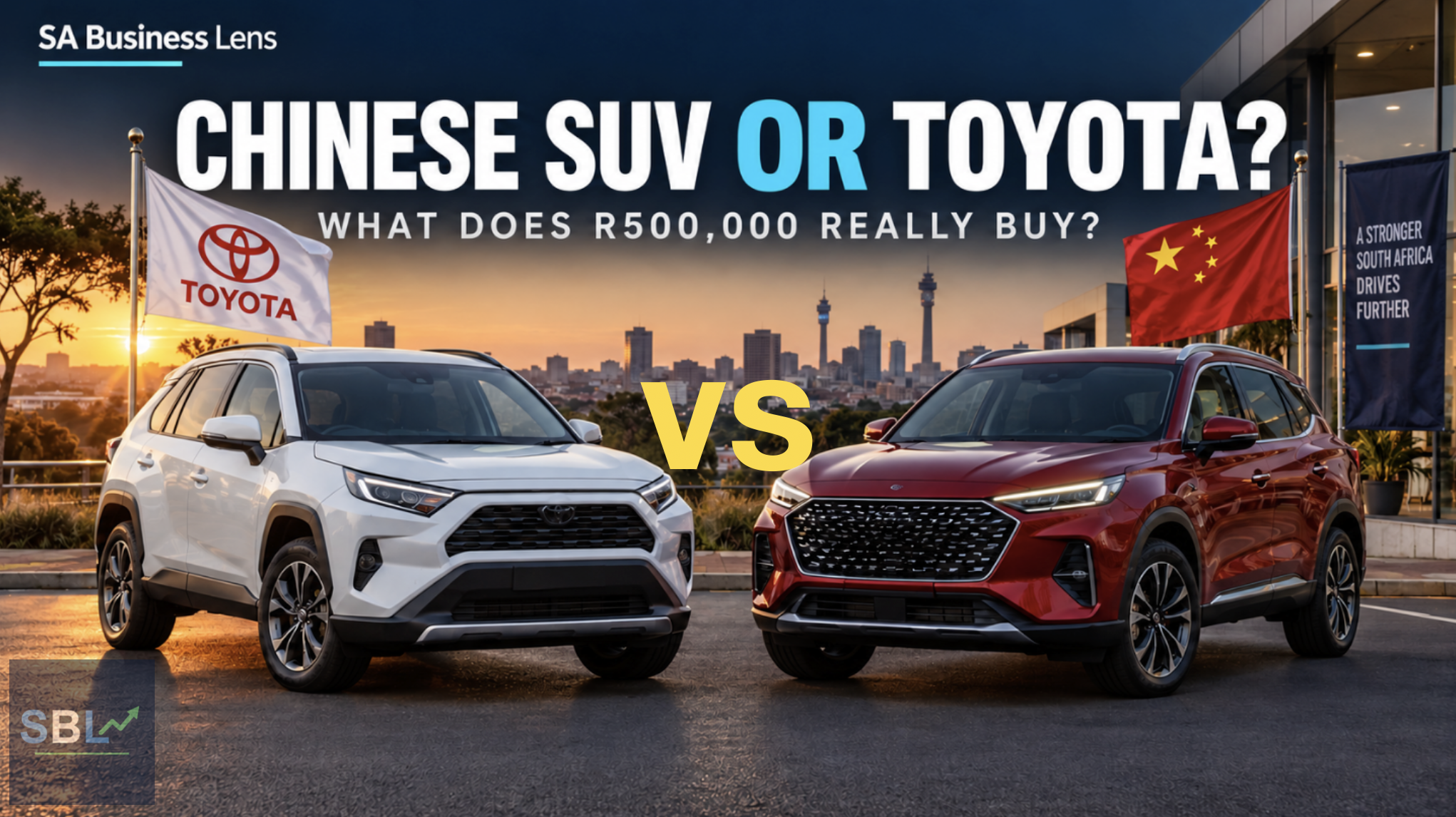
For years, the safe South African answer to the family-car question was simple: buy a Toyota. The badge stood for reliability, a large dealer network, readily available parts and strong resale value. That logic still carries weight, but Chinese manufacturers have made the decision far less obvious.
Today, a buyer with roughly R500,000 can choose between a familiar Toyota, a larger and more powerful Chinese SUV, or a feature-packed crossover that costs tens of thousands less. The real question is no longer whether Chinese vehicles are cheap. It is whether their extra equipment and longer warranties outweigh Toyota’s reputation and resale advantage.
What R500,000 actually buys you
These are current South African list prices and published specifications checked on 14 October 2026. Promotional finance deals, dealer discounts and optional extras can change the final amount.
R511,200
- 1.8-litre petrol hybrid
- 4.3 L/100 km claimed
- 3-year/100,000 km warranty
- 6 services/90,000 km service plan
R499,900
- 1.6-litre turbo, 145 kW and 290 Nm
- 7.2 L/100 km claimed
- 5-year/150,000 km vehicle warranty
- 5-year/60,000 km service plan
R465,900
- 1.5-litre turbo, 115 kW and 230 Nm
- 6.9 L/100 km published for the updated C5 line
- 5-year/150,000 km vehicle warranty
- Modern dual-screen cabin and driver aids
| Comparison | Toyota Corolla Cross | Chery Tiggo 7 | Omoda C5 |
|---|---|---|---|
| Upfront price | Highest of the three | R11,300 less than Toyota | R45,300 less than Toyota |
| Power | Hybrid system focused on efficiency | 145 kW and 290 Nm | 115 kW and 230 Nm |
| Fuel use | 4.3 L/100 km | 7.2 L/100 km | 6.9 L/100 km |
| Warranty | 3 years/100,000 km | 5 years/150,000 km, plus conditional engine cover | 5 years/150,000 km, plus conditional engine cover |
| Main attraction | Efficiency, reputation and resale confidence | Size, power and equipment for the price | Technology and a lower purchase price |
Why the Chinese option is tempting
The immediate appeal is easy to understand. At similar money, the Chery offers substantially more power and a longer standard vehicle warranty. The Omoda leaves more room in the budget while still offering the technology that many buyers now expect, including large screens, smartphone integration and modern safety equipment.
This matters when monthly instalments are already stretched. A panoramic camera, powered tailgate, larger display or more complete driver-assistance package can cost extra on an established brand, while Chinese manufacturers often include those features in the asking price.
There is also a psychological shift taking place. Buyers can now see growing numbers of Chery, Haval, Omoda, Jaecoo and Jetour vehicles on South African roads. These are no longer unusual purchases made by a tiny group of early adopters.
Where Toyota still makes the strongest case
Toyota’s advantage becomes clearer when the car is viewed as a five-year or seven-year ownership decision rather than a showroom purchase. Its national dealer footprint is broad, independent workshops know the products, and parts availability is generally well understood.
Resale value is the hardest part of the Chinese proposition to predict. A generous warranty does not automatically guarantee what a dealer will offer for the vehicle in five years. Toyota’s long record gives used-car buyers confidence, and that confidence often protects the trade-in price.
The Corolla Cross hybrid also has a genuine running-cost advantage in this comparison. At the official consumption figures, a driver covering 20,000 km a year could use hundreds of litres less fuel than with the two turbo-petrol alternatives. Real-world results will vary, but the difference is large enough to include in the buying decision.
INTERACTIVE VALUE CHECK
What could depreciation cost over five years?
Toyota
Estimated depreciation R178 920
Chinese SUV
Estimated depreciation R224 955
Toyota has the lower estimated depreciation cost.
Illustrative assumptions only, not forecasts. Actual resale values vary. Excludes finance, fuel, insurance, maintenance and repairs.
What about reliability?
No honest comparison can promise how every vehicle will perform over a decade. Toyota has decades of local evidence behind it. Newer Chinese models do not yet have the same South African history, even when the manufacturer offers a long warranty.
That does not mean a Chinese vehicle is automatically unreliable. It means the buyer should read the warranty conditions, ask whether cover transfers to the next owner, confirm service intervals, and check the location of authorised repair centres. A warranty is only as useful as the support available when something goes wrong.
So, why would you buy the Chinese car?
You might choose it because you plan to keep it within the warranty period, you value cabin technology and safety equipment, and you want more space or performance for the purchase price. The Chery in this comparison gives a lot of vehicle for slightly less than the Toyota.
You might still choose the Toyota because predictable ownership matters more than a longer specification sheet. Fuel efficiency, resale confidence and a familiar support network can easily be worth more than extra screens or power.
The best answer depends on how long you will keep the car. A buyer who changes vehicles every three to five years should pay close attention to resale value. A buyer who intends to keep the vehicle for a decade should examine warranty exclusions, long-term parts supply and service support. A buyer who mainly drives in traffic may place greater value on the Toyota hybrid’s fuel use.
Price is what you pay on delivery day. Value is what the vehicle costs, saves and returns over the years that follow.
THE SA BUSINESS LENS DEBATE
You have about R500,000 for an SUV. Which would you choose?
Sources
Toyota South Africa: Corolla Cross
Chery South Africa: Tiggo 7
Omoda South Africa: current offers


Leave a Reply